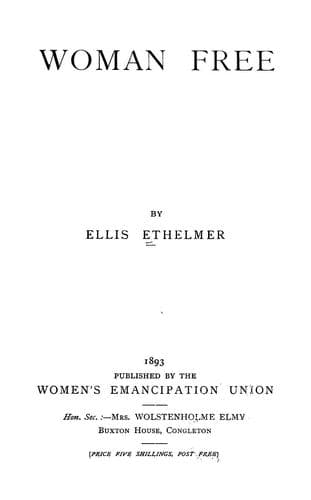
English poetry -- 19th century; Women -- History; Women -- Social conditions; Women -- Suffrage
“For we see that it is possible to interpret the ideals of ethical
progress, through love and sociality, co-operation and sacrifice, not as
mere utopias contradicted by experience, but as the highest expressions
of the central evolutionary process of the natural world.... The older
biologists have been primarily anatomists, analysing and comparing the
form of the organism, separate and dead; however incompletely, we have
sought rather to be physiologists, studying and interpreting the highest
and intensest activity of things living.... It is much for our pure
natural history to recognise that ‘creation’s final law’ is not
struggle, but love.”—Geddes and Thomson (“The Evolution of Sex,” pp.
312, 313).
5; 6.—“_Conformed to claims of intellect and need,
The tempered numbers of their high-born breed_;”
“There is a problem creeping gradually forward upon us, a problem that
will have to be solved in time, and that is the steady increase of
population.... I believe that with the emancipation of women we shall
solve this problem now. Fewer children will be born, and those that are
born will be of a higher and better physique than the present order of
men. The ghastly abortions, which in many parts pass muster nowadays,
owing to the unnatural physical conditions of society, as men, women,
and children, will make room for a nobler and higher order of beings,
who will come to look upon the production of mankind in a diseased or
degraded state as a wickedness and unpardonable crime, against which all
men and women should fight and strive.”—Lady Florence Dixie (“Gloriana,”
p. 137).
_Id._... And Mrs. Mona Caird says:—“If the new movement had no other
effect than to rouse women to rebellion against the madness of large
families, it would confer a priceless benefit on humanity.”—(_Nineteenth
Century_, May, 1892.)
_Id._... “To bring a child into existence without a fair prospect of
being able, not only to provide food for its body, but instruction and
training for its mind, is a moral crime, both against the unfortunate
offspring and against society.... The fact itself of causing the
existence of a human being, is one of the most responsible actions in
the range of human life. To undertake this responsibility—to bestow a
life which may be either a curse or a blessing—unless the being on whom
it is bestowed will have at least the ordinary chances of a desirable
existence, is a crime against that being. And in a country either
over-peopled, or threatened with being so, to produce children, beyond a
very small number, with the effect of reducing the reward of labour by
their competition, is a serious offence against all who live by the
remuneration of their labour.”—J. S. Mill (“Liberty,” Chap. V.).
_Id._... A. Dumas fils draws a true and piteous picture in which this
element of the unintelligent overproduction of human beings has the
largest share:—
Public-domain text, read in full here on John Shaqi.
Reviews
Reviews
No reviews yet
Be the first to share your thoughts on this work.
Elsewhere in the archive
Join the Discussion
Join the discussion
Sign in to leave a comment or review.
Sign InorCreate an account