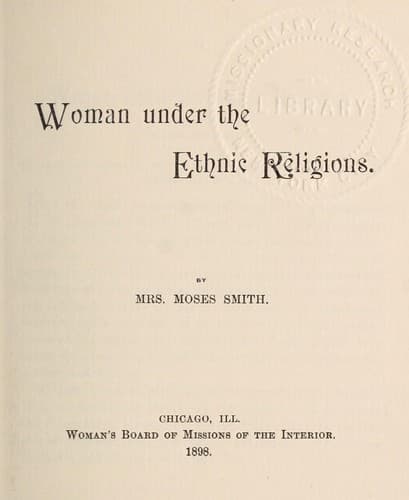
Woman under the ethnic religionsSmith, Moses, Mrs.
Religion
Woman under the ethnic religions
Smith, Moses, Mrs.
Women -- Religious life; Women and religion
Note the polygamous teaching of the Koran. “Every Moslem is allowed
four free wives and as many concubines as his right hand possess;” and
the faithful are positively promised that in Paradise they shall have
seventy-two houris for wives, besides the wives they have here.
[Sidenote: Divorce.]
According to the Koran, the husband may divorce a wife without
warning or assigning a reason. The husband has only to say, “Thou art
divorced.” Even life may be taken at the will of the husband. Woman is
practically a chattel. A Mohammedan being asked, “What is the price you
pay for a good wife,” replied; “About the same as for a mule, twelve or
fourteen pounds.”
[Sidenote: Estimate.]
A polite Mohammedan would not speak of his wife without using the
same apologetic formula he would use if he were speaking of a donkey
or a hog. Indeed so degrading is the orthodox Mohammedan’s idea of
womanhood, we cannot mention it here. The Koran says nothing about a
woman’s praying, therefore she is excluded from the Mosques at the
hours of prayer. Behold a religion that practically excludes one-half
the human race! It was not until Mohammed was fifty-eight years of age,
and the husband of many wives, and had under his own roof experienced
what the Moslem women of to-day declare, when there is more than one
wife “there is fire in the house,” that he wrote in the Koran the
“ordinance of veil,” that badge of jealous subjugation, which marks
an era in the degradation of women in all the Orient. The regulation
costume shrouds the women from the head to the ankle in a cotton or
silk sheet of black or white. Around the head is tied a yard long linen
or cotton veil in which before the eyes is a piece of open work about
the size of a finger which is the only look out and ventilator. No
part, not even a hand or an eye, can be seen.
See the picture; with fearful foot-steps, with no hope in man, with
little knowledge of the “All Father,” no knowledge of Him who said,
“Come unto me all ye that labor and are heavy laden,” for twelve
cycling centuries, an unceasing ghostly procession has marched from
birth to death.
Theckla, a Christian martyr of the first century, standing in the
arena at Antioch, bemoans in her prayer the shame of all women in her
unclothing. The clothing of woman in the veil of the false prophet is
a shame to all womanhood. “The whole life of a Mohammedan woman is
mirrored in that pathetic Arabic proverb ‘The threshold weeps for forty
days whenever a girl is born.’” The spider’s web which once saved the
life of Mohammed has, as by the hand of a Vulcan, been forged into a
chain which in this nineteenth century in the name of religion dares
hold woman, and through her, 200,000,000 of mankind in a singularly
hopeless degradation.
[Sidenote: Persia.]
Public-domain text, read in full here on John Shaqi.
Reviews
Reviews
No reviews yet
Be the first to share your thoughts on this work.
Join the Discussion
Join the discussion
Sign in to leave a comment or review.
Sign InorCreate an account