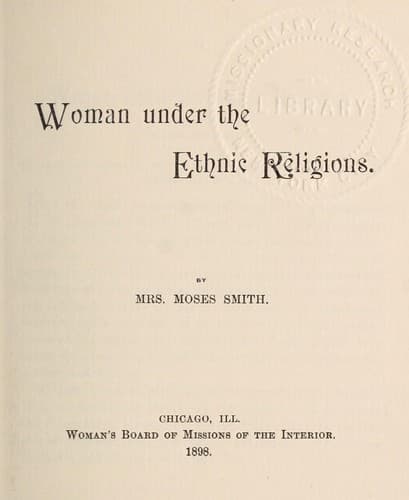
Woman under the ethnic religionsSmith, Moses, Mrs.
Religion
Woman under the ethnic religions
Smith, Moses, Mrs.
Women -- Religious life; Women and religion
The years go by and centuries are numbered. We find the fulfilled
promise of a “great nation” in a people in whose veins on the one
side is filtering the blood of the great Abraham, mingling with the
larger proportion of the idolatrous Egyptian, nomadic in habit, with
a genius for conquest, with a language distinguished for softness and
copiousness, with a literature of great antiquity and high poetical
merit, dwelling in the Peninsula of Arabia. Of these people, in the
fifth century of the Christian era, Mohammed, the founder of Islam, was
born. A youth of great sincerity and purity, his domestic life with his
wife, Khadija, is as beautiful as could be found among a non-Christian
people. But when at the age of fifty-two he sets himself up as a
prophet, and becomes the husband of eleven wives, we find him guilty
of the grossest crimes, robbery, murder, and butchery which rival the
Emperor Nero.
“Judged by the smallness of the means at his disposal, and the extent
and permanence of his work, his name is illustrious. By his will
he abolished a cherished idolatry and bowed to himself the hearts
of his countrymen, and gave to the world a creed which has been a
tremendous force on the destinies of the nations. To the impulse he
gave, numberless dynasties owe their existence. Fair cities, stately
palaces and temples have arisen. At a thousand shrines the voice of
the faithful invokes blessings on him.”[12] “He saw with a correct
spiritual vision the elemental truth of all religion. There is only one
God.”[13] For twelve centuries the teachings of Mohammed have borne
fruit in human lives. Not only in the land of its birth, but in many
lands.
[12] Marcus Dodd.
[13] Dean Milman.
[Sidenote: Koran.]
We turn the pages of the Koran with eager hope that we may find in the
writings of this man some teaching that shall lead to the uplifting
of woman. The most hopeful word the Koran has for woman is in the
second chapter: “Whoso doeth good works and is a believer, whether
male or female, shall be admitted to Paradise.” The practical exegesis
of a woman’s “good works” is, obedience to the husband. Without that
good work she can not enter Paradise. Again in the fourth chapter,
entitled “Women,” we read, “Men shall have pre-eminence above women,
because of those advantages wherein God hath caused the one to excel
the other, and for that which they expend of their _substance in
maintaining their wives_. The honest women are obedient, careful in
the absence of their husbands, for that God preserveth them by
_committing them to the care and protection of the men_. But those,
whose perverseness ye shall be apprehensive of, rebuke and remove them
into separate apartments and chastise them.” The degraded and degrading
practice of scourging and beating wives, having the sanction of the
Koran, will be, in the words of Dr. Jessup, “indulged in so long as
Islam as a faith prevails.”
[Sidenote: Polygamy.]
Public-domain text, read in full here on John Shaqi.
Reviews
Reviews
No reviews yet
Be the first to share your thoughts on this work.
Join the Discussion
Join the discussion
Sign in to leave a comment or review.
Sign InorCreate an account