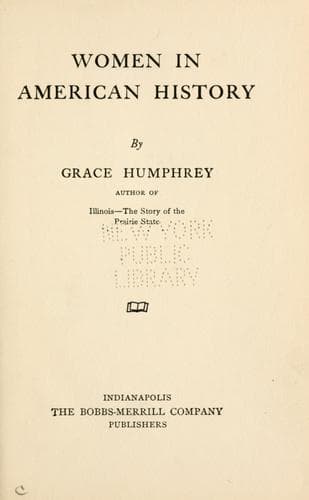
Women -- Biography; Women -- United States -- Biography
The sentence of banishment was carried out in March of 1638. To the
sorrow of many of the colonists, William Hutchinson went with his wife.
He refused their invitations to remain, saying, “For I am more dearly
tied to my wife than to the church.... And I do think her a saint and
servant of God.” With husband and children and seventy friends Mistress
Anne went to Rhode Island where Roger Williams offered the party a
friendly refuge. From the Indians they bought an island, for ten coats,
twenty hoes, and forty fathoms of white wampum; and lived there until
1642 when William Hutchinson died.
Hearing a rumor that Massachusetts was trying to extend her control
over Rhode Island, the settlers left for a new site in the Dutch colony
to the west. A year later a friendly Indian one morning visited Anne
Hutchinson’s house. Seeing that the family was defenseless he returned
that night with others of his tribe, killed the sixteen members of the
household and set fire to the buildings.
When Governor Winthrop heard of this massacre he declared that
“the bare arm of God displayed itself in her death.” Ministers in
Massachusetts announced it a divine judgment supporting their verdict.
One of them wrote, “God’s hand is more apparently seen herein to
pick out this woful woman to make her and those belonging to her an
unheard-of heavy example above others.” But Mistress Anne’s friends
charged the guilt of her murder upon the colony and declared it was the
judgment of the Lord on Massachusetts.
An able woman, clever, brilliant, possibly indiscreet in her criticism
of the ministers, Anne Hutchinson’s life was a strange mixture of
consecration and conflict, of kindliness and contention, with a tragic
end. She was fighting the first battle in a long series to be fought
out in America--for religious toleration and for freedom of thought and
speech, for liberty of conscience, for a true democracy in religion.
CHAPTER III
BETSY ROSS
1752-1836
In 1752 the eighth child was born in the Quaker family of Griscom in
Philadelphia, and was named Elizabeth. Nine other children came after
her, so with a total of sixteen brothers and sisters you may be sure
she never had much opportunity to be lonely. Perhaps the large number
of children is the explanation for her being apprenticed at Webster’s,
the leading upholstery establishment in the city. There Elizabeth
became acquainted with John Ross, one of her fellow-apprentices; their
friendship grew to love, and when she was twenty-one they were married.
Now John Ross was the son of an Episcopal clergyman and because of that
fact Elizabeth was “disowned” by the Friends for her marriage.
Public-domain text, read in full here on John Shaqi.
Reviews
Reviews
No reviews yet
Be the first to share your thoughts on this work.
Join the Discussion
Join the discussion
Sign in to leave a comment or review.
Sign InorCreate an account