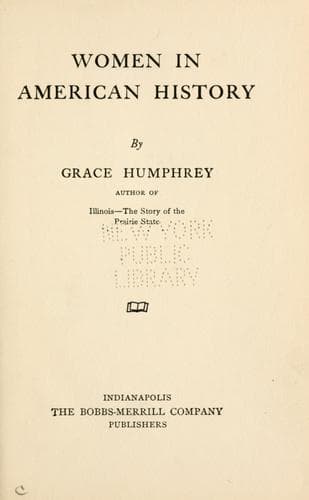
Women -- Biography; Women -- United States -- Biography
After a few months in Williamsburg, to settle the business of the
Custis estate and to attend the meetings of the House of Burgesses, of
which Washington had been elected a member during his campaign against
the French, he took his bride to Mount Vernon, his eight-thousand acre
plantation on the Potomac River. Here they planned to live quietly, he
busy with his fields and flocks, she with the large household, and both
enjoying the growth of the Custis children. In a white apron and cap,
with a bunch of keys jingling at her side, Mrs. Washington supervised
the busy kitchen and slave quarters, looked after the strict training
and the lessons of the children, and was a charming hostess to their
guests.
But public affairs changed and with them this quiet happy life. The
stamp act and oppressive taxes stirred the colonies. Like many patriot
women, Martha Washington ceased using tea at her table, ceased to buy
English cloth and other goods of English manufacture. No less than
sixteen spinning-wheels were kept busy at Mount Vernon, and on the
looms homespun was woven for the family’s clothing and for the large
number of slaves.
Rapidly events moved to a crisis. The first Continental Congress was
called, and Washington elected as one of Virginia’s three delegates.
When the party started north Mrs. Washington saw them off with these
words of wifely appreciation, “I hope you will all stand firm. I know
George will. God be with you, gentlemen.”
And this was not idle talk on her part, for she foresaw plainly the
consequences. At the many discussions and debates which had occurred at
their home, for and against English policy, she had said little, but
had listened intelligently. She summed it up in writing to a friend:
“Dark days and darker nights, domestic happiness suspended, social
enjoyments abandoned, property put in jeopardy--but what are all these
evils when compared with the fate of which the Port Bill may be only a
threat? My mind is made up, my heart is in the cause.”
The second Congress met the following May and Washington was
unanimously chosen commander-in-chief of the army. He wrote this news
to his wife at Mount Vernon, adding that he hoped to return in the
autumn. Instead he then invited her to come to him in Cambridge, but
carefully pointed out the difficulties of the journey. Unhesitating,
undismayed, a true soldier’s wife, she set out for the long trip to
the North, as though it were the most natural thing in the world to
leave the ease and security of her southern home and spend the winter
in a New England camp on the outskirts of a city held by the enemy.
Public-domain text, read in full here on John Shaqi.
Reviews
Reviews
No reviews yet
Be the first to share your thoughts on this work.
Join the Discussion
Join the discussion
Sign in to leave a comment or review.
Sign InorCreate an account