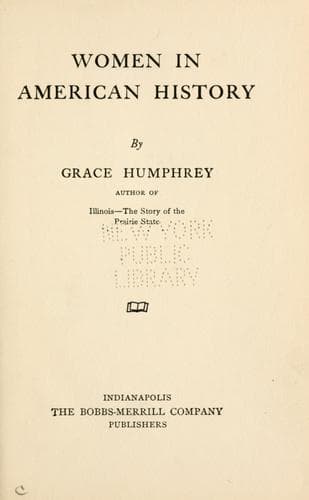
Women -- Biography; Women -- United States -- Biography
What would they have done without Sacajawea? Dauntless and determined,
always cheerful and resourceful, she had in her care the lives and
fortunes of the whole party. It was she who gathered plants unknown
to the white captains and cooked them into a mush. It was she who
varied their monotonous diet by roasting, boiling and drying fennel
roots, and stewing wild onions with their meat. It was she who found
berries and edible seeds when starvation seemed the only outcome. She
searched in the prairie dogs’ holes with a sharp stick and discovered
wild artichokes, as valuable as potatoes, with a delicious flavor. She
taught the white men how to break shank bones of elk, boil them and
extract the grease to make “trapper’s butter.” When Clark was ill she
made bread for him with some flour she had saved for her baby--the only
mouthful he tasted for days.
Late in November they reached the coast and spent the winter, a forlorn
group, at Fort Clatsop. There was much sickness and the strength of
the men began to fail. There was nothing but dried fish for food, and
it rained and rained till their clothes and bedding rotted away.
They had a strange celebration on Christmas day, when the men sang
songs in the morning, and the Bird-woman brought a gift to Clark--two
dozen white weasels’ tails!
In January during a brief interval of sunny weather, they planned to
go to the beach to get oil and blubber from a whale that was reported
stranded there. Sacajawea had heard of the Pacific in the legends of
her tribe, she had heard of whales too, and begged to be allowed to go.
Had she traveled all that long way only to fail to see the great waters
and the great fish? So Clark agreed that she should accompany them.
When they arrived the Indians had already disposed of the whale, the
skeleton, a hundred and five feet long, being all that was left.
Because of sickness and scant stores of food, bitterly disappointed
when no trading ships appeared with fresh supplies, they began the
return trip early in March instead of in April. Progress was so rapid
that the journey which westward had lasted for full eight months, was
made in five, and six weeks of this time was taken up by a detour. The
party divided and Clark, with Chaboneau and Sacajawea as guides, went
to explore the Yellowstone.
In August they were once more at the Minnetaree village where the
Bird-woman had first seen the white captains and their mill for
grinding corn. Here the leaders said good-by to their Indian friend and
guide. Clark offered to take the family to the states, give them land,
horses, cows and hogs to start farming, or a boatload of merchandise
as a stock for trading. But Chaboneau preferred to remain among the
Indians, saying he had no acquaintance in the East and no chance of
making a livelihood. Clark then offered to take the baby, “my little
dancing boy Baptiste,” now eighteen months old, and bring him up as his
own child, but Sacajawea refused.
Public-domain text, read in full here on John Shaqi.
Reviews
Reviews
No reviews yet
Be the first to share your thoughts on this work.
Join the Discussion
Join the discussion
Sign in to leave a comment or review.
Sign InorCreate an account