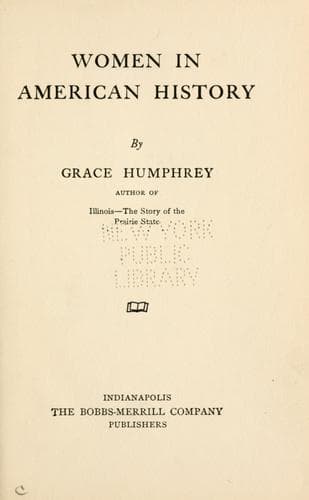
Women -- Biography; Women -- United States -- Biography
“You shall have enough the next time,” he responded. And the
government, recognizing the value of her service, gave her ten wagons
and sixty mules and drivers.
Her work succeeded because she had initiative and practical judgment
and rare executive ability and the power of managing men. When her
drivers were rebellious and sulky, showing little respect for orders
that put them under a woman, she controlled them just as she had the
rough boys in her school. Once she prepared a hot dinner and asked them
to share it. After she had cleared away the dishes and was sitting
alone by the fire, awkward and self-conscious they came up to her.
“Come and get warm,” she welcomed them.
“No’m, we didn’t come for that,” said the leader. “We come to tell you
we’re ashamed. Truth is, lady, we didn’t want to come. We knew there
was fightin’ ahead, an’ we ain’t never seen a train with a woman in
charge. Now we’ve been mean and contrary all day long, and here you’ve
treated us like we was the general and his staff, and it’s the best
meal we’ve had in two years and we shan’t trouble you again.”
The next morning they brought her a steaming hot breakfast and for
six months remained with her, through battles and camps and marches,
through frost and snow and heat, a devoted corps of assistants, always
ready for her orders. They helped her nurse the sick and dress the
wounded and soothe the dying, and day by day they themselves grew
gentler and kinder and more tender.
Once Clara Barton worked for five days and nights with three hours of
sleep. Once she had a narrow escape from capture. Often in danger it
seemed as though she had a special protection that she might save the
lives of others. Stooping to give a wounded soldier a drink of water,
a bullet whizzed between them, tearing a hole in her sleeve and ending
the boy’s life.
She gave her help to men who had fought on either side. They were
suffering, they needed her, that was enough. No man is your enemy
when he is wounded. She leaned over a dying officer in a hospital; a
Confederate looked up into her kind face and whispered:
“You have been so very good to me. Do not cross the river, our men are
leading you into an ambush. You must save yourself.”
But his warning was unheeded when later that day the hero-surgeon who
was opening an emergency dressing-station across the river, asked her
help. She went over to Fredericksburg where every stone wall was a
blazing line of battle. A regiment came marching down the street. She
stepped aside. Thinking she must be a terrified southerner, left behind
in their hurried flight, the general leaned from his saddle to ask:
“You’re alone and in great danger, madam. Do you want protection?”
“Thank you, but I think”--Clara Barton looked up at the ranks of
soldiers marching past--“I think, sir, I’m the best protected woman in
the United States!”
Public-domain text, read in full here on John Shaqi.
Reviews
Reviews
No reviews yet
Be the first to share your thoughts on this work.
Elsewhere in the archive
Join the Discussion
Join the discussion
Sign in to leave a comment or review.
Sign InorCreate an account