Equal pay for equal work; Sex discrimination against women; Wages -- Women
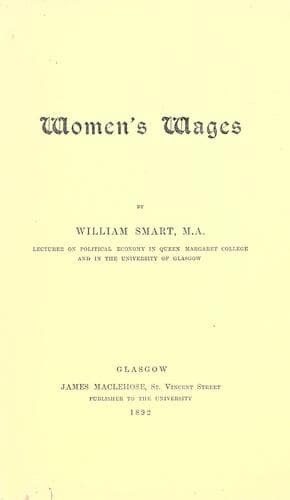
Women's Wages
"Give her the wages of going on, and not to die."
Women's Wages
BY
WILLIAM SMART, M.A.
LECTURER ON POLITICAL ECONOMY IN QUEEN MARGARET COLLEGE
AND IN THE UNIVERSITY OF GLASGOW
GLASGOW
JAMES MACLEHOSE, ST. VINCENT STREET
PUBLISHER TO THE UNIVERSITY
1892
A paper read before the PHILOSOPHICAL SOCIETY OF GLASGOW,
9th Dec., 1891.
WOMEN'S WAGES.
It is not necessary to prove that women's wages are, as a rule, much
under those of men. In the textile trades of Great Britain, which
constitute the largest department of women's work, the average of
women's wages is probably--in Scotland it is certainly--about ten
shillings per week. This labour is not by any means unskilled, as anyone
who has ever seen a spinning or weaving factory knows. Twenty shillings
per week, however, is a low average for a man possessing any degree of
skill whatever.
In a paper read before the British Association at Cardiff, Mr. Sidney
Webb gave some valuable statistics on the subject. Women workers he
divides into four classes--manual labourers, routine mental workers,
artistic workers, and intellectual workers. The two latter classes may
be dismissed in a word. Sex has little to do in determining the wages of
their work. A novelist, a poet, a writer of any sort, is under no
disadvantage that she is a woman, while in many departments of artistic
work women have an obvious advantage. But in the third class, that of
routine mental workers, Mr. Webb finds that women's earnings are
invariably less than men's. In the Post Office and Telegraph
Departments, in the Savings Banks, and in the Government offices
generally, where women do precisely similar work with men, and are
sometimes, as in ledger work, acknowledged to do it better, they
invariably earn much less. The largest experiment yet made in this
direction is that of the Prudential Life Assurance Office, which began
in 1872 to substitute women clerks for the lower grades of men clerks.
There are now 243 ladies employed in routine clerical work, which they
are said to do more efficiently than men. The salaries run thus:--£32
for the first year, £42 for the second, £52 for the third, and £60 on
promotion--probably half of what men might be expected to accept. In
Glasgow lady typists and shorthand writers are offering their services
from 9.30 till 5, with one hour for dinner, for £25. In the teaching
profession women almost invariably receive lower remuneration than men.
The Education Department Report of 1888-90 gives the average wage of
teachers throughout England and Wales as £119 for men and £75 for women.
Similarly low salaries are found under the London School Board, in the
Secondary Schools, and in girls' schools generally as compared with
boys' schools.
Public-domain text, read in full here on John Shaqi.
Reviews
Reviews
No reviews yet
Be the first to share your thoughts on this work.
Join the Discussion
Join the discussion
Sign in to leave a comment or review.
Sign InorCreate an account