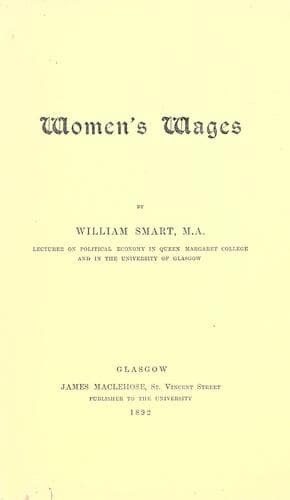
Equal pay for equal work; Sex discrimination against women; Wages -- Women
The exception noted by Mr. Webb is interesting and, I think, suggestive.
In the United States, where women teachers often alternate with men in
the same school, the salaries of women are habitually lower. But in the
State of Wyoming, where women have a vote, the salaries are equal.
Coming now to the manual workers, Mr. Webb takes the statistics
furnished by the Massachusetts Bureau of Statistics of Labour in 1884.
These give the average of 17,430 employés in 110 establishments in Great
Britain, and 35,902 employés in 210 establishments in Massachusetts,
representing in both cases 24 different manufacturing industries. The
women's wages show a proportion of one-third to two-thirds the amount
earned by men, the nearest approach to equality being in
textiles--cotton goods, hosiery, and carpetings in Great Britain,
woollen and worsted goods in Massachusetts. Without going further into
statistics, I think we may assume the fact of a great disparity between
men's and women's wages, and go on to ask the reason of it.
If we put the question in general terms, Why is a woman's wage less than
that of a man? there are some answers that spring to the lips of
everyone. First, it is said that it is a mere question of supply and
demand. Second, that women are not usually the sole bread-winners in the
family to which they belong. Third, that their standard of living is
lower than that of men. Fourth, that their work is not so good as that
of men. Fifth, that the commodities made by women have, generally, a
less value in the market. There is truth in all these answers, but I
propose to show that each of them is at best a half truth, raising as
many questions as it settles.
The first answer given is that women's wages are low because of the
equation of supply and demand. Only certain branches of industry are
open to women. In these there is a great number of women competing for
employment. They are free to take work or refuse it. But over the
industrial community there are found enough women willing to take the
low wage which employers find they can offer, and free competition
determines the level. If two women run after one employer, wages will
fall; if two employers run after one woman, wages will rise.
Public-domain text, read in full here on John Shaqi.
Reviews
Reviews
No reviews yet
Be the first to share your thoughts on this work.
Join the Discussion
Join the discussion
Sign in to leave a comment or review.
Sign InorCreate an account