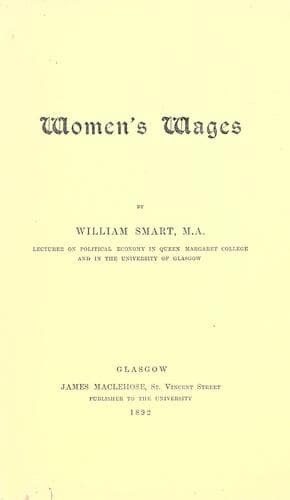
Equal pay for equal work; Sex discrimination against women; Wages -- Women
This is probably quite true. Once the prices are down, it is difficult
to see how wages can be higher. But what brought down the prices? Is it
ever the case that the world of consumers, practically, go to the
workers and ask them to accept low wages on the ground that they can
only afford low prices? Experience does not bear this out. So far as I
know, the initiative of reducing prices, as a rule, comes from the
producers, not from the public. The history of prices of most
commodities of large use is something like this. They are at first dear,
and only a small circle of consumers can afford them. As the production
becomes organised, and capital brings more and more appliances to bear
on the manufacture, the goods become cheaper, and a wider circle of
demand is found. But below each circle of actual demand there are
endless and widening circles of potential demand ready to take any
particular commodity if it can be had cheaper. Thus, as, up to a certain
point, large production is cheap production, there is always an
inducement to the manufacturer and merchant to produce more cheaply. If
they can reduce prices, and get down to a lower circle of consumers, it
is well known in practical experience that the increase of trade which
follows is out of all proportion to the degree of the reduction of
price. But when this movement has gone on for some time, and goods have
become very cheap, the demand has a way of appearing imperative,
especially if these goods have entered into the standard of comfort of
great classes. The goods become "necessary;" the low prices meet a
"natural" demand; and these prices are just enough to yield an average
profit to the employer--for profit must have its average, or capital, as
we are often warned, will fly the country.
This is all quite true. The fallacy emerges only when it is suggested
that the low prices are the cause of low wages. Here there are two
possibilities: (1) All the reduction of cost may have been effected by
perfecting machinery, organising production, and bringing producer and
consumer together--that is to say, all the cheapening may have come from
the side of capital. In this case there is no room for laying low wages
at the door of cheapened prices. Or (2) as wages constitute one of the
chief costs in all production--in the United States, for instance, they
make up on an average a quarter of the manufacturing cost--they may
have been reduced along with the capital expenses, and the low prices be
partly due to these low wages.
Public-domain text, read in full here on John Shaqi.
Reviews
Reviews
No reviews yet
Be the first to share your thoughts on this work.
Join the Discussion
Join the discussion
Sign in to leave a comment or review.
Sign InorCreate an account