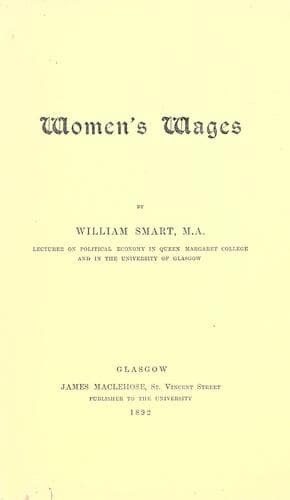
Equal pay for equal work; Sex discrimination against women; Wages -- Women
We thus come naturally to the fifth answer given to our question. It
points to the fact that the kind of commodities made by women, or in
women's trades, have, generally, a less value in the market--they are
"cheap" goods. Even as a mere statement of fact this proposition is very
loose. What are cheap goods? In the absence of any absolute standard of
value, goods can be called cheap only as comparing present prices with
prices of similar goods in the past, or in consideration of their cost
of production as compared with other goods. If the former is meant, all
modern manufactured goods are cheap, and this would not explain the
lower wage of one sex. If the latter, it is prejudging the whole
question. But to make this statement an explanation, and suggest that
cheap prices are the cause of low wages, is surely to turn the causal
connection the wrong way about; for the value of goods such as we are
speaking of depends, according to the recognised theory, on cost of
production, and of this cost of production wages is a large part. It is
true that the connection between prices and wages is one on which
economic science is somewhat slow to speak. We may not now be so
confident as Mill was when he put the proposition "high prices make high
wages" among common erroneous notions. And we may not be prepared to
say with him that the effect of prices on wages is only indirect,
through increased profits adding to capital. But we are not prepared, I
think, to go in face of all our old faith, and declare that the _prices_
of goods determine their cost of production!
But as a fallacy is not usually put in a bald form, we must consider the
concrete case in which it is assumed. Let us take an industry--say a
branch of the textile trade--where labour constitutes a great part of
the costs of production. Suppose that for many years low prices have
ruled for the particular class of goods made. Any attempt to raise wages
here meets with an obvious criticism. It seems most plausible to say: It
is the wants of the people which have established this demand. The
present price is all the consumers can or will pay, and the low wage is
all that these prices can afford.
Public-domain text, read in full here on John Shaqi.
Reviews
Reviews
No reviews yet
Be the first to share your thoughts on this work.
Join the Discussion
Join the discussion
Sign in to leave a comment or review.
Sign InorCreate an account