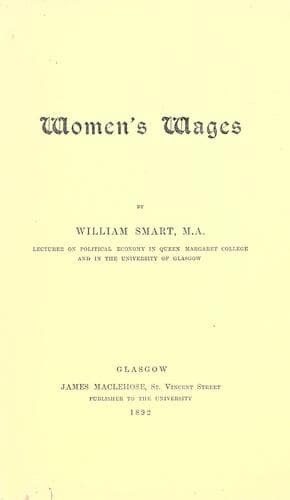
Equal pay for equal work; Sex discrimination against women; Wages -- Women
But there is an exceptional circumstance in their case. It is that the
women are in the same strong Trade Union with the men, and under the
same obligations to the Union, and that any attempt to reduce the wages
of the one sex would be resisted with the whole strength of both. But
what if this Union were to break down?
It is as certain as anything based on experience can be that in a few
weeks, or even days, it would be possible for the employers to reduce
the wages of the women-workers; that, rather than lose their work, women
would consent to the reduction; that, as they accepted lower wages, men
would drop off to other industries, and would cease to compete for the
same work; and that, in a comparatively short time, power-loom weaving
would be left, like its sister cotton-spinning, to women-workers
exclusively, and wages fall to the general level of women's wage. For
what we are apt to forget is the constant inducement before the employer
to reduce women's wages. There are two ways in which a manufacturer can
add to his profits. One is by getting up his prices, the other by
reducing his costs. In the present state of competition we know what the
chance of getting up prices is, unless there is some element of monopoly
in the case, and even then it generally requires a combination or
syndicate of makers. But the employer is always looking out for ways of
reducing cost. Theoretically, the most obvious way of all is by reducing
wages. In men's trades, where reductions of wage are jealously watched,
employers think twice, however, before they try that particular
reduction of cost. In many factories, again, women's wages are purely
customary, and employers would not think of touching them. But in the
factories where wages are customary and almost fixed, the wages are also
_low_. If the customary wages in cotton-spinning were 16s. a week
instead of 10s., I venture to think that employers, in times of keen
competition, would be inclined to try a reduction. I mean that, if the
customary level of women's wages is 10s., the reason why it does not go
lower is chiefly because it cannot.
And here, I think, we are at the root of the matter. In looking over the
field of factory industries, in order to arrive at an average of women's
wages, it has struck me that the variations from the average of 10s. a
week are comparatively small. This is not an average made up from
widely different wage-bills, and from widely varying individual wages,
but from pay sheets that show small amounts of variation on one side or
other.
This definiteness of average wage seems to me most explicable on the
supposition that women's wages are very near the only quite definite
level that political economy has ever pointed out, the level of
subsistence.
Public-domain text, read in full here on John Shaqi.
Reviews
Reviews
No reviews yet
Be the first to share your thoughts on this work.
Join the Discussion
Join the discussion
Sign in to leave a comment or review.
Sign InorCreate an account