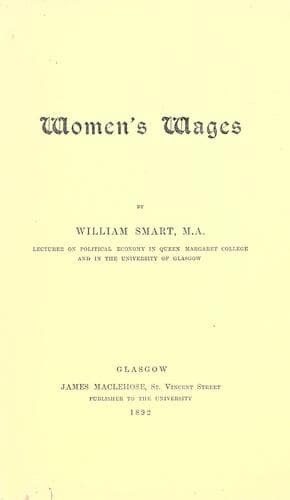
Equal pay for equal work; Sex discrimination against women; Wages -- Women
There are two ways, known to theory, of determining wage. In a
progressive society, where wealth is rapidly increasing, the tendency
will be towards payments by _results_, that is to say, by value of
product. Product being in this case the result of the co-operation of
land, labour, and capital, the problem is to find the share in that
product which is economically due to labour--that is to say, the share
"attributable" to the efficacy of labour. In a poor or backward society,
again, where labour and capital are struggling with an unfriendly
environment, and the return to industry is still uncertain, the risk and
the chances of speculation in the return are left to the only class who
can take risks, the capitalists.
England long ago passed from the latter to the former description of
society, and of her increased wealth the men-workers have obtained, we
may suppose, something like a share corresponding to the increased value
of the joint product. But, owing to want of organisation of
women-workers, it is yet possible to pay women by the other
standard--namely, according to their _wants_--and to keep them at the
same level of wage as they were content to take half-a-century ago.
It seems to me, in fact, that while men's wages, unless in the case of
unskilled workers, are determined ultimately by the value of product
which is economically "attributable" to their work, women's wages are
determined by the older and harsher law. "The wages, at least of single
women," said Mill, "must be equal to their support, but need not be more
than equal to it; the minimum in their case is the pittance absolutely
required for the sustenance of one human being.... The _ne plus ultra_
of low wages, therefore (except during some transitory crisis, or in
some decaying employment), can hardly occur in any occupation which the
person employed has to live by, except the occupations of women."
But, indeed, it is a lower depth to which women's wages have fallen than
the "sustenance of one human being." There may be persons that think
10s. a week is sufficient to keep a grown-up factory girl, living by
herself, in healthy and decent life. It certainly is true that in many
cases it has to serve till she accepts the release of marriage; but
surely the marriage of the English girl, factory or otherwise, is a
matter too serious to have the escape from a miserable wage added to its
attractions. It is sufficiently obvious that this level of wage was
never determined by sustenance, but by the competition of the "single
woman" with married women and widows who will take any wage rather than
see their children starve, with girls sent into the factory to add their
few pence per week to the earnings of the head of the house, and with
children.
If this is so, what are the remedies? They are, briefly, organisation
and enlightenment of the public conscience.
Public-domain text, read in full here on John Shaqi.
Reviews
Reviews
No reviews yet
Be the first to share your thoughts on this work.
Join the Discussion
Join the discussion
Sign in to leave a comment or review.
Sign InorCreate an account