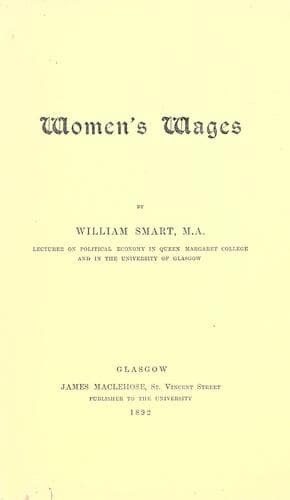
Equal pay for equal work; Sex discrimination against women; Wages -- Women
First, organisation is necessary to protect women against employers and
against themselves--the one no less than the other. The true enemies of
the workers' organisations are, on the one hand, the grasping employer,
and, on the other, the "blackleg" worker. By the grasping employer I
mean the employer who really wishes to make a gain at the expense of the
people whom he employs; it is easy to see why he dislikes the trade
union. But the good employer--if he could only lift his horizon a
little--would see that he requires the help of the trade union, inasmuch
as he cannot keep up the wages if the workers do not assist him. The
best, the most amiable and just manufacturer, must sell his goods at the
same prices as his rivals. If these rivals, by securing low-priced
labour, can reduce the prices of their goods, he is almost forced to
reduce his wages. Consequently, if the trade unions could prevent
low-priced labour being offered they would most materially assist the
great majority of employers--for I am sanguine enough to believe that
most employers are anxious to pay their workers as high a wage as they
can. But the best employers are helpless to remedy the evils of a class
of workers who are hopelessly at war among themselves, and ready to take
each a lower wage than the other. Where a girl, coming out of a
comfortable home, is willing to take ten shillings a week because to her
it is "pocket money;" where the mother of five will take eight shillings
because her husband is out of work and she is the sole bread-winner;
where the mother of ten will accept six shillings because she has so
many mouths to feed; where the girl just in her teens will take four
shillings because she is a little girl--where all these different
women, with different motives, are competing against each other for
equal work, there is no remedy but the severe one of _preventing_ these
poor souls from dragging down the wage of each other. If women are ever
to get a fair day's wage on the ground of a fair day's _work_, as
distinguished from the wage determined by a woman's necessity, it will
only be by the old remedy of combination and the protection of the
average working woman against the more helpless members of her own sex.
But, second, enlightenment of the public conscience must supplement
organisation. It should not be difficult to convince educated people
that women's work should be paid on the same principle as that of
men--that is to say, according to their product, and not according to
their wants; and to make them pay, or insist on the worker being paid,
equal wages for equal work. But the point on which enlightenment does
seem very much needed is that of the supposed necessity for low wages.
Public-domain text, read in full here on John Shaqi.
Reviews
Reviews
No reviews yet
Be the first to share your thoughts on this work.
Join the Discussion
Join the discussion
Sign in to leave a comment or review.
Sign InorCreate an account