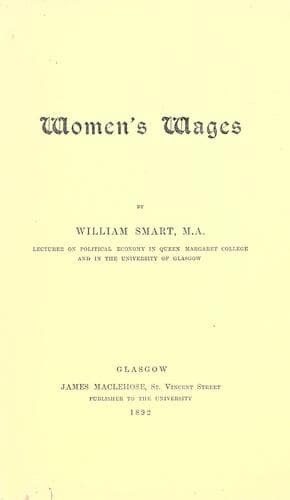
Equal pay for equal work; Sex discrimination against women; Wages -- Women
There is, indeed, no formula in political economy on which the modern
economist looks with more suspicion than that of Supply and Demand. The
operation of supply and demand as determining market price is, of
course, perfectly definite; but to say that any concrete price is fixed
by the equation of supply and demand is a mere statement of an observed
fact which says little, unless one knows and defines accurately what is
involved in the "supply," what is involved in the "demand," and how
those two factors stand related to each other. The price of railway
stock to-day is determined by supply and demand; the price of a man's
labour, whether unattached or working under restriction of the Trade
Union, is determined by supply and demand; the earnings of the poor soul
who sells her body on the streets are determined by supply and demand.
What does this formula tell us unless we know the complex phenomena
which determine the supply of railways and the demand for transit, the
supply of labourers and the demand for work, the supply of hapless women
and the demand for human souls? To say, then, that women's wages are low
because there are enough women who take the low wage, is little more
than to say that wages are low because people are paid low wages. We
have still to ask: What are the factors, or influences, or motives,
that make women take a wage below that of men, and what are the factors
that make employers offer the low wage?
Apart from the general insufficiency of this first answer, it is enough
to remember that the determination of wage by this mechanical equation
of supply and demand could be tolerable only under absolutely free
competition, which would involve perfect mobility of labour. But labour
has this unique characteristic among all commodities that, physically,
it is not mobile; historically, it has never been mobile; and ethically,
it should not be mobile. A man's labour is--and should be--his life, not
the mere instrument of providing a living; and, therefore, in the
question of wages it is impossible to ignore the ethical consideration.
Civilised society could not hold together if the workman and workwoman
could only get their fair share of the world's boundless wealth by
changing their trade, their residence, or their country, as a higher
wage offered itself.
Public-domain text, read in full here on John Shaqi.
Reviews
Reviews
No reviews yet
Be the first to share your thoughts on this work.
Join the Discussion
Join the discussion
Sign in to leave a comment or review.
Sign InorCreate an account