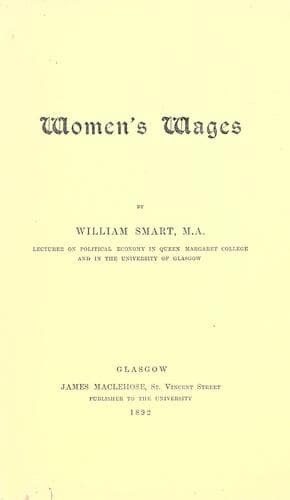
Equal pay for equal work; Sex discrimination against women; Wages -- Women
Those who think this answer an easy and satisfactory one must be unaware
of the unsettling of many problems since Mill's day. Mill had no less
than three laws of value--that of the Equation of Supply and Demand,
that of Cost of Production, and that of Differential Cost of Production.
The former law, he said, applied to goods of which the quantity was
naturally, or artificially, or temporarily, limited, and it was,
besides, the sole determinant of the value of labour. But then Mill was
assuming a definite Wage Fund--a fixed portion of the circulating
capital of the country predestined for the payment of wages. This
definite sum, and no more, was to employ all the workers, however many
they might be. If, then, wages fell, the reason was obvious--there were
too many workers. Wherever Mill touches on low wages we have a sermon on
the evils of over-population, and his favourite explanation did not fail
him here. "Where employers take full advantage of competition, the low
wages of women are a proof that the employments are overstocked." But
this is logical only if "overstocking" is the sole possible cause of low
wages--which might be doubted even under a Wage Fund theory. But the
Wage Fund is now one of the antiquities of political economy. Since
Jevons we have looked for the measure of value in marginal utility; for
the value of productive goods in their marginal utility as instruments
of production; and for the value of labour in the value of its products,
and not in any predetermined fund divided out among a variable number
of workers by the action of supply and demand. And where invention is
constantly widening and strengthening our power over natural resources
and increasing the productiveness of labour, the presumption is against
the idea that over-population is even a strong factor in modern wages.
Public-domain text, read in full here on John Shaqi.
Reviews
Reviews
No reviews yet
Be the first to share your thoughts on this work.
Join the Discussion
Join the discussion
Sign in to leave a comment or review.
Sign InorCreate an account