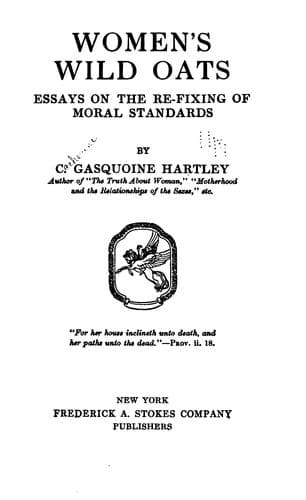
Women's Wild Oats: Essays on the Re-fixing of Moral Standards — John Shaqi
Women's Wild Oats: Essays on the Re-fixing of Moral StandardsHartley, C. Gasquoine (Catherine Gasquoine)
History
Women's Wild Oats: Essays on the Re-fixing of Moral Standards
Hartley, C. Gasquoine (Catherine Gasquoine)
Women -- Great Britain; Women -- Social and moral questions
You will see what I wish to make plain. Those whom I criticize are
dealing with symptoms instead of working to remove the real cause of the
disease. They work hard and achieve little. Of course their efforts are
praiseworthy, and, under present conditions, frightfully necessary. But
they are just about as lastingly useful as trying to mend a badly broken
china cup at home with cheap cement. You know what happens: as soon as
you succeed in getting two pieces to stick together another piece
tumbles away, and, at last, if by excessive patience the work gets done
and the cup is mended, the first shock of hot water makes all the pieces
again fall apart. It is a solution that gives great opportunity of
employment, one indeed that goes on forever; perhaps that is why it
fascinates the child-like minds of the feminists. I want something very
different.
I want a tradition of life to hand on to our daughters and to their
daughters. We need a strongly deepened sense of womanly responsibility,
wide-spread and universally accepted; an up-to-date sense, if you like
that term. I have no fears of change. I would re-fix our moral standards
more fearlessly than many who think me old-fashioned. But what I want
to insist upon is this: _The standard of conduct must be fixed for
women._ Our children want something settled, not everything left
uncertain. Our morals (I do not mean our sexual morals only, but our
whole ethical and social conduct) has become like a skein of wool that
has been unraveled by a puppy. We want a firm broad way in which it is
good and possible for all of us to walk without hurting one another, not
the horrid scramble that to-day we accept as life.
The modern conception of personal rights is essentially individualistic,
and has arisen only under industrial values of life; the result of its
further application as a social criterion for women, must logically be
exactly what it has been in the experience of the past century: a bitter
and brutal struggle for self-aggrandizement, with the failures
remorselessly crushed underfoot, and the very idea of a fixed common
responsibility and common good for all forgotten or denied. My plea for
women is, therefore, based not upon the notion of equal rights, but
rather upon that of equal duties. Moral equality means equality in the
will to serve--not self, but all. And the practical correlative of this
conception must be a social organization which secures equalities of
opportunity for service to women and men. The only rights I desire to
claim for my sex are those necessary to the discharge of its own duties;
the fulfillment of the instinctive maternal craving; the realization of
the deepest impulses of a woman's nature.
Public-domain text, read in full here on John Shaqi.
Reviews
Reviews
No reviews yet
Be the first to share your thoughts on this work.
Join the Discussion
Join the discussion
Sign in to leave a comment or review.
Sign InorCreate an account