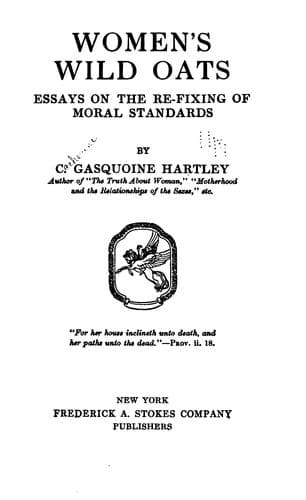
Women's Wild Oats: Essays on the Re-fixing of Moral StandardsHartley, C. Gasquoine (Catherine Gasquoine)
History
Women's Wild Oats: Essays on the Re-fixing of Moral Standards
Hartley, C. Gasquoine (Catherine Gasquoine)
Women -- Great Britain; Women -- Social and moral questions
The pitiless war of every individual against his, or her, fellow waged
with gold or with steel, can never make life other than mean and empty.
Women and men must learn again to regard themselves as part of a
mightier whole, one of the human race, and, as we feel in moments of
deeper insight, of the universe, which is a unity in spite of all the
discords it contains.
It follows from this, that I am not greatly concerned with what any
individual woman, or group of women, can do, or cannot do, should be
encouraged to do, or be restrained from doing, in competition with men
and with each other, but rather what is most right and worth while for
all women, _as women_, to do. _I do not want freedom for each woman to
do what she wants._
You see, in my view of life, such freedom can lead only to a more
degraded slavery. And because I am certain about this, I do not desire
success for women in the blind struggle based on the doctrine (so
fundamentally untrue in my opinion) of personal rights. A doctrine which
results inevitably in separations, in hatreds, in disorders and
struggling one with another. Unity of ideals and of conduct becomes
impossible. The general life is driven about in this way or the other,
directed by this purpose or by that, but always by individualistic
principles, and not to serve the good of all, but by each person for his
own, or her own, ends. How can order come out of such a way of life? Do
you think you are going to improve things in the old selfish ways. I
tell you the result can be nothing but a further failure of vision. The
mountain heights become obscured by the mists going up from the damp
valleys, and the soul loses its way.
FOOTNOTES:
[23:1] The statistics show the situation up to April, 1918.
[24:1] The words I have italicized are not mine, but are quoted from the
Report.
[27:1] It is worth noting that, as far as I know, no word of protest has
been made by women against these statements. The Report, since I wrote
this chapter, has been widely commented on in the daily papers, in some
of the weeklies, and in all the suffrage papers, but these passages have
been passed over. Surely this is very significant.
[28:1] Since published by the Fabian Society as a small book.
[31:1] An excellent article on the Report, entitled "Demobilization of
Juvenile Workers," by Miss L. B. Hutchins, appeared in the _Contemporary
Review_, February, 1919.
[38:1] Since writing this, the Government, backed by the Labor Party,
has passed its Pre-war Practices (Restoration) Bill, which will exclude
women from many of the trades which they have entered during the war;
trades in which they have done skilled work and received high wages. On
August 15, The Sex Disqualification (Removal) Bill, after a promising
early career, went by default.
_Second Essay_
THE COVENANT OF GOD
WAR MARRIAGES AND ROMANTIC LOVE, WHICH CONTRASTS THE ENGLISH IDEAL OF
PERSONAL HAPPINESS IN MARRIAGE WITH THAT HELD BY THE JEWS OF MARRIAGE AS
A RACIAL DUTY.
Public-domain text, read in full here on John Shaqi.
Reviews
Reviews
No reviews yet
Be the first to share your thoughts on this work.
Join the Discussion
Join the discussion
Sign in to leave a comment or review.
Sign InorCreate an account