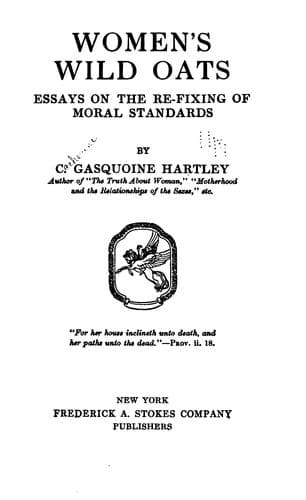
Women's Wild Oats: Essays on the Re-fixing of Moral StandardsHartley, C. Gasquoine (Catherine Gasquoine)
History
Women's Wild Oats: Essays on the Re-fixing of Moral Standards
Hartley, C. Gasquoine (Catherine Gasquoine)
Women -- Great Britain; Women -- Social and moral questions
"Which forsaketh the guide of her youth, and forgetteth the
covenant of her God."--Prov. ii. 17.
I
A few weeks ago I read a book about a war-marriage, entitled the "Wife
of a Hero"; it was not a good novel, but the situation it presented was
of great interest. We witness the manifold conflicts resulting from a
marriage entered into in haste and under superficial emotions, between a
war-hero and the more complicated type of modern woman--the woman of
brains and nerves, fastidious, intellectually passionate and at the same
time swayed by a sensuality, which is neither acknowledged nor
understood. Hence this woman's marriage with a man, who, sufficiently a
hero to die magnificently (as a matter of truth he does not die and
returns in the end to receive the Victoria Cross, but it was believed he
was dead) was quite unfitted to live decently. You see, his ideals did
not get any further than his vanity. In his view a woman--whether wife
or mistress, it did not signify which she was--was only a chattel, an
object to give enjoyment to him, in fact, a prostitute. He did not know
he felt this, could not know it, in fact. It would have needed a
revolution of his character to turn his vision to something other than
himself. Neither did the wife realize her egoism, an egoism more
agreeable certainly than was his, because on a less crude plane, but
equally reprehensible, as spiritually barren and limited to Self as was
that of the man.
Now, Miss Netta Syrett, the writer of the book, seems to be unaware of
such a failure on the woman's part. All the blame is shoveled on to the
hero, all the sympathy wrapped like a thick woolen cloud about the
heroine. Miss Syrett is a great feminist. As we should expect, the
marriage is broken in the Divorce Court. The returned and invalided
hero, decorated with his Victoria Cross, seeks happiness with an
earlier love, and a marriage is made of a frankly sensual character.
Meanwhile the heroine finds a spiritual mate in the person of an old
friend, and a second marriage is made. We are led to believe that all
the wrong is set right. Now, I doubt this. I believe the cause which
brought the first marriage to such painful disaster was not dependent
only on the evident unsuitability of the partners to live with one
another; the grossness of the man and the believed refinement of the
woman need not necessarily have failed in finding happiness in union.
No, the cause of failure was deeper, within themselves, dependent on the
blind egoism of both the husband and the wife and their wrong
understanding of the institution of marriage. I do not think that in
either case the second marriages were likely to be much happier than the
first marriage.
II
Public-domain text, read in full here on John Shaqi.
Reviews
Reviews
No reviews yet
Be the first to share your thoughts on this work.
Join the Discussion
Join the discussion
Sign in to leave a comment or review.
Sign InorCreate an account