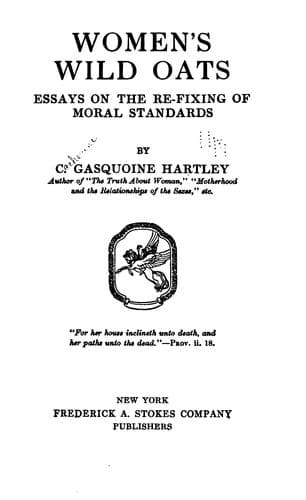
Women's Wild Oats: Essays on the Re-fixing of Moral StandardsHartley, C. Gasquoine (Catherine Gasquoine)
History
Women's Wild Oats: Essays on the Re-fixing of Moral Standards
Hartley, C. Gasquoine (Catherine Gasquoine)
Women -- Great Britain; Women -- Social and moral questions
Abundant evidence is forthcoming of the honor that was always paid by
the Jewish husband to his wife. His duties toward her are set forth in
detail in the usual form of the _Ketubah_. In the body of that
instrument he binds himself to work for her, and to honor her, to
support and maintain her. The Talmudic sayings on this subject of the
honor in which the wife is held and the husband's dependence on her are
numerous. Let me quote one or two: "Who is rich? He whose wife's actions
are comely. Who is happy? He whose wife is modest and gentle." Again: "A
man's happiness is all of his wife's creation"; and yet again: "God's
presence dwells in a pure and loving home." "Be not cruel or
discourteous to your wife," said a first century teacher, "if you
thrust her from you with your left hand, draw her back to you with your
right hand." Another says: "A man should always be careful lest he vex
his wife: for as her tears come easily, the vexation put upon her comes
near to God." A seventeenth century writer states: "Never quarrel with
your wife"; this is not to be done even "if she asks for too much
money."
Such passages extend in an unbroken series through all medieval Jewish
literature. But if the Jewish wife was held in honor by the Jewish
husband, it was because of the very practical virtues of the Jewish way
of living. The home life was everywhere serene and lovely, and if the
Jew retained any virtue at all, he displayed it in the home. The father
was the religious teacher of his family, and this duty necessarily
increased his domesticity. He took greater interest in his children
because it was his task to teach them the law, and his devotion to his
wife was directly dependent on his service to the family. One of the
Rabbis, on this question of the Jewish husband ill-treating his wife,
said in framing his regulations "This is a thing not done in Israel."
I would ask you to note that the woman does not become a nonentity by
reason of her limitation to a definite sphere of action within the
home. Such a view is entirely absent among the Jews. The rule over the
home-life held through the centuries by the Jewish wife is far more real
in its results of power than the so-called equality claimed by a modern
woman, acting under the influence of industrial ideals. What is
significant (and ought to teach us if we can be taught) is the fact that
such power is held by women in right of their position as wives and
mothers; it is never extended to young girls or to unmarried women on
account of their attraction and sexual power over men, in the way to
which we have become accustomed. That is unknown, at least, in
connection with marriage. The Jew understands that there are other ways
of loving than falling in love. Power is held universally by the house
mistress--the mother, whose desires through life are a law unto her
husband and her children.
Public-domain text, read in full here on John Shaqi.
Reviews
Reviews
No reviews yet
Be the first to share your thoughts on this work.
Join the Discussion
Join the discussion
Sign in to leave a comment or review.
Sign InorCreate an account