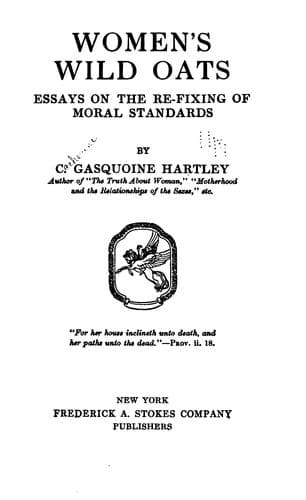
Women's Wild Oats: Essays on the Re-fixing of Moral Standards — John Shaqi
Women's Wild Oats: Essays on the Re-fixing of Moral StandardsHartley, C. Gasquoine (Catherine Gasquoine)
History
Women's Wild Oats: Essays on the Re-fixing of Moral Standards
Hartley, C. Gasquoine (Catherine Gasquoine)
Women -- Great Britain; Women -- Social and moral questions
All Jewish literature is filled with examples of reverence expressed
towards mothers who are "the teachers of all virtue." In the moral law
the command to fear the mother--that is to treat her with respect, is
placed even before the duty of fearing the father (Lev. xix. 8).
Enduring evidence remains of the spiritual status of mothers. When the
Prophet of Exiles wishes to depict God as the Comforter of his people,
he says "As one whom his mother comforteth, so will I comfort you" (Is.
lxvi. 13). When the Psalmist describes his utter woe, he laments, "As
one mourning for his mother, I was bowed down with grief."
Perhaps, now as we see the mother taken as the one sufficient symbol of
Jehovah's dealing with his people, the mourning for her presence being
the completest expression of grief, we can come to understand something
of the Jewish ideal of marriage and of the high honor, _because of this
ideal_, in which women were held.
VII
It should be plain enough now why English marriages so often are
unhappy. The immense failure of marriage to-day arises from the
confusion of our minds and our chaotic desires so that we have no firm
ideal, no fixed standard of conduct either for the wife or for the
husband. Every couple starts anew and alone, and the way is too
difficult for solitary experiments.
The existence of many standards, of what ought to be done and what
ought not to be done, the liberty permitted to the husband, the liberty
permitted to the wife, if the wife shall continue her work or profession
or remain at home dependent on the husband's earnings, whether the
marriage shall be fruitful or sterile--these are but a few of the
questions left undecided. And thus to leave unguided each wife and each
husband, with their own idea of what is good to do and what is evil,
makes for narrowness and waste of effort; while further, our inability
to set up a standard of right and wrong conduct--of ideals to strive
after--leaves vacant room for false ideals of every kind. These empty
places of the mind have been occupied by the ravings of advanced people.
The harm has been incredibly active in the consciousness of the young.
We have put before their imagination nothing worthy of contemplation,
therefore they easily sink downward attracted by what is base.
Then we suggest economic changes. But the evil is not economic. No evils
are fundamentally economic. The structure of society is the unforeseen
result of the conflicting desires and capacities of the individuals who
comprise the society. A false view of marriage, a false view of the
relative values of life and money, of service and liberty, of happiness
and duty, is not dependent on economic conditions. Yet, let us not
forget that this is the age of the gadding mind and the grabbing hand.
We tend to value everything by what it brings in to us, in feelings if
not in more tangible results.
Public-domain text, read in full here on John Shaqi.
Reviews
Reviews
No reviews yet
Be the first to share your thoughts on this work.
Join the Discussion
Join the discussion
Sign in to leave a comment or review.
Sign InorCreate an account