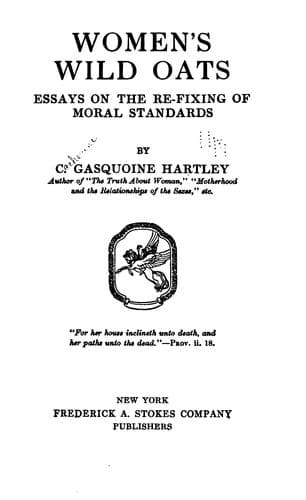
Women's Wild Oats: Essays on the Re-fixing of Moral StandardsHartley, C. Gasquoine (Catherine Gasquoine)
History
Women's Wild Oats: Essays on the Re-fixing of Moral Standards
Hartley, C. Gasquoine (Catherine Gasquoine)
Women -- Great Britain; Women -- Social and moral questions
A great number of people, regarding marriage as a mystical and,
therefore, unbreakable sacrament, object to divorce under any
circumstances whatever. This is the case in Catholic countries, such,
for instance, as Spain, the land I know and love so well. Such an
attitude I can understand and respect, though I do not consider it a
practical proposition, and know, moreover, that indissoluble marriage,
in some ways, works very harmfully. It prevents hasty marriage. In Spain
marriage is regarded as the gravest and most momentous step in life; but
this caution does not altogether work out for good in the way one might
expect.
I recall a conversation with a Spanish friend on this question. We were
speaking of the great numbers of young Spaniards who did not marry. I
asked my friend the reason of this. He answered: "You see we have no
divorce in this land as you have in England, that makes us afraid now we
have begun to think, we hesitate and hesitate, then we take a mistress
while we are deciding, but it is easier and less binding to live like
that, and we keep going on and put off marrying, sometimes put it off
until it is too late." In Spain the illegitimate birth-rate is the
highest of any country in Europe.
We must accept, then, that indissoluble marriage fails in practice, and
the society which enforces it commits self-injury by setting up a
standard of conduct impossible to maintain; and further, one that acts
in deterring the more thoughtful from marriage and leaves the protected
institution to the more reckless, who do not consider consequences.
Now, when once we do accept this, admit the principle of divorce and
acknowledge that in certain circumstances the bond of marriage may be
severed, at once the aspect of the question changes: it becomes a matter
of practical adjustment, so that what is needed is decision and
regulation of the conditions under which divorce should be allowed, so
that they may meet best the needs of men and women in the society and,
at the time, in which they live. I am very anxious to show the
difference between the practical and the conventional attitude toward
this problem. It is to be wished that this question of divorce could be
approached free from the falseness of the old prejudices of religious
intolerance and of sentimentality.
Public-domain text, read in full here on John Shaqi.
Reviews
Reviews
No reviews yet
Be the first to share your thoughts on this work.
Join the Discussion
Join the discussion
Sign in to leave a comment or review.
Sign InorCreate an account