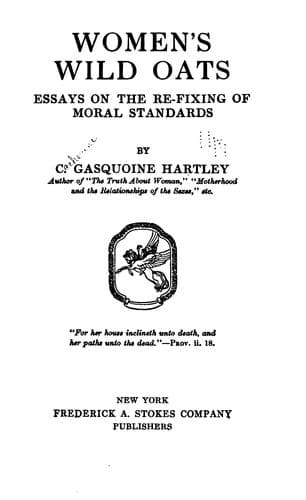
Women's Wild Oats: Essays on the Re-fixing of Moral StandardsHartley, C. Gasquoine (Catherine Gasquoine)
History
Women's Wild Oats: Essays on the Re-fixing of Moral Standards
Hartley, C. Gasquoine (Catherine Gasquoine)
Women -- Great Britain; Women -- Social and moral questions
The great and pressing need of reform is being widely discussed at the
present time. I note with a mixture of amazement and fear that
practically in every argument the opinion universally held appears to be
that the relief given should be as limited as possible; it is still
being taken for granted that free divorce in this country is neither
attainable nor desirable, and, indeed, that any extension of the grounds
of divorce would act against the sanctity of marriage. I say I note this
attitude with fear, because it seems to me that the triumph of prejudice
and ignorance here is a most serious symptom of the degradation of our
moral outlook and the poverty of our faith in the institution of
marriage.
"Divorce is relief from misfortune, not a crime," to quote from the
admirable statute book of Norway, a saying which should be one of
universal application in divorce. And this relief must be granted, not
merely as an act of justice to the individual; it is called for equally
in the interests of society.
The moral code of any society ought to meet the needs of its members.
But the needs change as time goes on, and moral codes must then also
change or they become worn-out and useless. That society which is
unwilling to modify its laws to fit new conditions drives its members
into defiance of the law and acts directly as a cause of immorality. It
were well to remember this as we come to question our laws of divorce.
There can be no possible doubt that as the law stands at present it does
not meet the needs of those people who claim its relief; while further,
the most superficial knowledge of the situation proves how harmfully and
immorally the law acts.
II
It is, of course, very much better that marriage should be as permanent
as possible, and any society is obviously justified in bringing any
moral pressure to bear to make people realize the seriousness of the
relationship and the importance of keeping it permanent when possible.
But it is certainly no part of the right or duty of society to use force
to compel people to remain in the marriage relationship, when it becomes
so repugnant to them that the conditions of the marriage cannot be
continued. All that society has the right then to demand is that all the
obligations which have been assumed shall be honorably fulfilled. But a
relationship registered in mistake or under delusion should be subject
to revision, and, with certain safeguards, to dissolution, otherwise the
standard of morality is degraded and marriage itself is brought to
contempt, and can be used, as indeed too often it is, as a cloak of
protection for every kind of immorality.
Public-domain text, read in full here on John Shaqi.
Reviews
Reviews
No reviews yet
Be the first to share your thoughts on this work.
Join the Discussion
Join the discussion
Sign in to leave a comment or review.
Sign InorCreate an account