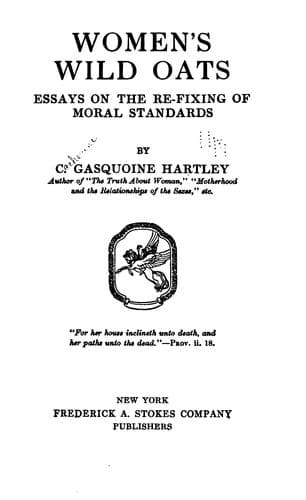
Women's Wild Oats: Essays on the Re-fixing of Moral Standards — John Shaqi
Women's Wild Oats: Essays on the Re-fixing of Moral StandardsHartley, C. Gasquoine (Catherine Gasquoine)
History
Women's Wild Oats: Essays on the Re-fixing of Moral Standards
Hartley, C. Gasquoine (Catherine Gasquoine)
Women -- Great Britain; Women -- Social and moral questions
The case where one partner only of the marriage desires its dissolution
is much more difficult, and cannot, I think, be settled with the same
justice. I would, however, point out that the same situation is common
before marriage, when an engagement is broken by one or other of the
lovers, though, of course, the pain and injury (if such words can be
used in this connection) must be much greater after marriage. The law
allows in these cases compensation to be claimed by the injured partner
for the harm suffered, and, though no one can uphold these breach of
promise cases (which have increased so unfortunately in the war-period)
it should be possible to avoid a similar sordidness. The establishment
of right to compensation is not a new thing in divorce; used in the way
I suggest it would serve as a safeguard against a too hasty escape from
marriage, as well as being an act of justice for the partner who wished
for the divorce to compensate, as fully as his or her means or working
capacity permitted, the one who desired the continuance of the marriage.
The amount of compensation offered, as well as the amount claimed, if
there was not an agreement between the partners, should be stated when
application for the divorce is made; and this question should be settled
before any further proceedings are allowed. The required periods of
waiting would, of course, be enforced.
It may be interesting to my readers to learn that this principle of
compensation, given by the partner who claims divorce to the one who
does not desire it, is one that is common among many primitive peoples,
especially wherever customs of maternal descent prevail.[106:1] It is
practiced, to give one instance, by the Khasis, a maternal people of the
hill tribes of East India; it affords an example of how much more
wisely, because more simply, these matters are sometimes arranged,
before civilization destroys our common sense.
VIII
So far, I have ignored the real difficulty of divorce--the child or
children. At once the situation alters; when children are born both the
practical needs and moral values are different. A marriage that becomes
creative cannot be broken without grave disaster; for all creative
things are eternal. What, then, must be done? Frankly, I know of no one
workable plan, and I can suggest nothing except that in all cases the
welfare of the children should be taken as the standard to which the
desire of the parents should be subordinate.
Public-domain text, read in full here on John Shaqi.
Reviews
Reviews
No reviews yet
Be the first to share your thoughts on this work.
Join the Discussion
Join the discussion
Sign in to leave a comment or review.
Sign InorCreate an account