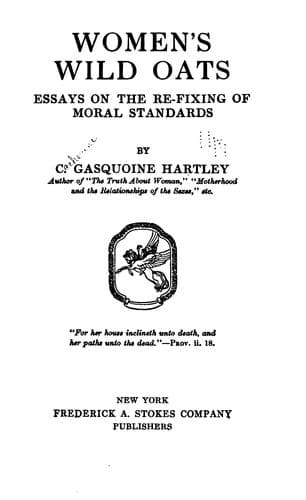
Women's Wild Oats: Essays on the Re-fixing of Moral StandardsHartley, C. Gasquoine (Catherine Gasquoine)
History
Women's Wild Oats: Essays on the Re-fixing of Moral Standards
Hartley, C. Gasquoine (Catherine Gasquoine)
Women -- Great Britain; Women -- Social and moral questions
Nor do I believe there need be cause for fear in this idea of divorce by
mutual consent. It is not nearly so easy to break a marriage that has
lasted for any time as is usually thought by those who have never tried
to do it. The habit of living together forges bonds you do not feel
until you try to break them. The intimacy of marriage creates a thousand
and one little every-day interests and ties, habits, preoccupations and
memories in common; when they are torn it is like tearing thousands of
little nerves that are far more painful than the one big hurt that
caused them to be broken. That is why most marriages are dissolved
through anger, in jealous passion, and because lovers are found out. It
needs immense courage to sever a marriage if you have time to think what
you are doing.
VII
About no subject, perhaps, are prejudices so rampant as they are about
this question of changing the marriage laws. I am, however, very certain
that I am right here. Nothing but good would follow from this
introduction of plain simple honesty. There would be fewer divorces, and
not more, if our laws were freed from their obsession with sexual
offenses, and divorce was made a question of quiet and careful
consideration, and mutual thought and decision.
There ought certainly to be a period of waiting after the application
for divorce, which should be signed by both the partners of the
marriage. I would suggest that the first application should be made to
lapse of itself unless a further application for its enforcement was
made after a period of--say, two years. Many people will go on with what
they have begun, even if they don't want to do so, because they are not
brave enough publicly to say they have made a mistake. After the second
application a further period of waiting, not less than a year, might be
required before the decree for dissolution of the marriage was made
absolute.
I cannot understand how any honest mind can fail to see the advantages
of this or some similar plan of divorce by mutual desire and
arrangement, over the present law which forces the committal of perjury
and requires adultery; nor can I find any reason why freedom should not
be granted, when the marriage is childless and both partners, after
sufficient deliberation, desire its dissolution. Probably it would be
wiser, as a further necessary safeguard against too hasty parting, to
require the marriage to have lasted for five years, before application
for its dissolution could be made. I think, however, in urgent cases,
and wherever it could be shown that the marriage had been entered into
under a mistake and had been continuously unhappy, it should be possible
to remit this requirement.
Public-domain text, read in full here on John Shaqi.
Reviews
Reviews
No reviews yet
Be the first to share your thoughts on this work.
Join the Discussion
Join the discussion
Sign in to leave a comment or review.
Sign InorCreate an account