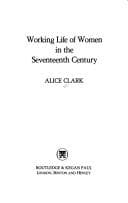
Working Life of Women in the Seventeenth CenturyClark, Alice
History
Working Life of Women in the Seventeenth Century
Clark, Alice
Women -- Employment -- Great Britain -- History -- 17th century; Women -- Great Britain -- History -- 17th century
The account books of Boroughs and Parishes show that the poor received
medical treatment from men and women indiscriminately. A whole series of
such payments occur in the minute book of the Dorchester Corporation.
“It is ordered that the Vˡⁱ to be paid to Peter Salanova for cutting of
Giles Garrett’s leg shall be paid out of the Xˡⁱ yearly paiable out of
the Hospitall for pious vses ... to have the one halfe having cutt of
his leg already, and the other halfe when he is thoroughly cured.[612]
... Unto the Widdow Foote xs. for the curing of the Widow Huchins’ lame
leg at present; and xs. more when the cure is finished[613].... Mr.
Losse should be payed by the Steward of the Hospital the somme of viij
li for his paynes and fee as Phisitian in taking care of the poore of
the Towne for the last yeare ... as it hath bin formerly accustomed....
Vnto Mr. Mullens the somme of thirty shillings for curing Hugh Rogers of
a dangerous fistula.”[614] Three pounds more (three having already been
paid) was ordered to be given to “Cassander Haggard for finishing the
great cure on John Drayton otherwise Keuse.”[615] In another case the
Council tendered to Mr. Mullens, “the chirurgeon, the some of xxxˢ for
curing of Thomas Hobbs, but he answered hee would consider of it next
weeke [He declined].”[616]
Footnote 612:
_Ibid._ Vol. XVIII., p. 196. _Accounts of Parish of Mayfield._
Footnote 613:
_Cratfield Parish Papers_, p. 179., 1640.
Footnote 614:
Mayo, C. H., _Municipal Records of Dorchester_, p. 516, 1640.
Footnote 615:
_Ibid._ p. 518, 1651.
Footnote 616:
_Ibid._ p. 518, 1649-50.
At Cowden the overseers paid to Dr. Willett for “reducing the arm of
Elizᵗʰ Skinner, and for ointment, cerecloths and journeys, £2;” three
years later a further sum of 10s. was given “to Goodwife Wells for
curing Eliz Skinner’s hand.”[617] Mary Olyve was paid 6s. 8d. “for
curing a boye that was lame” at Mayfield,[618] and 15s. was given to
“Widow Thurston for healing of Stannard’s son,” by the churchwardens at
Cratfield.[619] In Somerset £5 was paid to “Johane Shorley towards the
cure of Thomas Dudderidge. Further satisfaction when cure is don.”[620]
Footnote 617:
_Ibid._ pp. 518-9. 1652-1654.
Footnote 618:
_Ibid._ p. 519.
Footnote 619:
_Sussex Arch. Coll._, Vol. XX., p. 114. _Account Book of Cowden_,
1690.
Footnote 620:
_Somerset Q.S. Records_, Vol. III., p. 212. 1653.
Such entries show that though women may have practised surgery and
medicine chiefly as domestic arts, nevertheless their skill was also
used professionally, their natural aptitude in this direction enabling
them to maintain their position throughout the seventeenth century even
when deprived of all opportunities for systematic study and scientific
experiments, and in spite of the determined attacks by the Corporations
of physicians and surgeons; but their success was owing to the fact that
Science had as yet achieved small results in the standard of medical
efficiency.
Public-domain text, read in full here on John Shaqi.
Reviews
Reviews
No reviews yet
Be the first to share your thoughts on this work.
Elsewhere in the archive
Join the Discussion
Join the discussion
Sign in to leave a comment or review.
Sign InorCreate an account