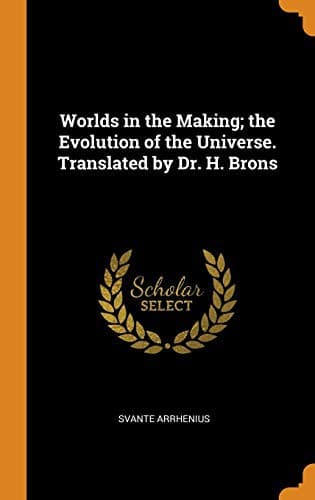
Worlds in the making: The evolution of the universeArrhenius, Svante
Science
Worlds in the making: The evolution of the universe
Arrhenius, Svante
Cosmogony
Stability of the solar system.—Losses and possible
gains of heat by the sun.—Theses of Mayer and of
Helmholtz.—Temperatures of the white, yellow, and
reddish stars, and of the sun.—Sun-spots and sun
faculæ.—Prominences.—Spectra of the parts of the
sun.—Temperature of the sun.—The interior of the sun.—Its
composition according to the mechanical theory of heat.—The
losses of heat by the sun probably covered by the enormous
solar energy.
IV. THE RADIATION PRESSURE 94
Newton’s law of gravitation.—Kepler’s observation of comets’
tails.—The thesis of Euler.—Proof of Maxwell.—The radiation
pressure.—Electric charges and condensation.—Comets’ tails
and radiation pressure.—Constituents and properties of comets’
tails.—Weight of the solar corona.—Loss and gain of matter
by the sun.—Nature of meteorites.—Electric charge of the
sun.—Electrons drawn into the sun.—Magnetic properties of
the sun and appearance of the corona.—Constituents of the
meteors.—Nebulæ and their heat and light.
V. THE SOLAR DUST IN THE ATMOSPHERE. POLAR LIGHTS AND THE
VARIATIONS OF TERRESTRIAL MAGNETISM 118
The supply of dust from the sun rather
insignificant.—Polarization of the light of the sky.—The
upper clouds.—Different kinds of auroræ.—Their
connection with the corona of the sun.—Polar lights and
sun-spots.—Periodicity of polar lights.—Polar lights and
magnetic disturbances.—Velocity of solar dust.—Fixation of
atmospheric nitrogen.—The Zodiacal Light.
VI. END OF THE SUN.—ORIGIN OF NEBULÆ 148
The extinction of the sun.—Collision between two celestial
bodies.—The new star in Perseus.—Formation of nebulæ.—The
appearance of nebulæ.—The nebulæ catch wandering meteors and
comets.—The ring nebula in Lyra.—Variable stars.—Eta in
Argus.—Mira Ceti.—Lyra and Algol stars.—Evolution of the
stars.
VII. THE NEBULAR AND THE SOLAR STATES 191
The energy of the universe.—The entropy of the
universe.—The entropy increases in the suns, but
decreases in the nebulæ.—Temperature and constitution
of the nebulæ.—Schuster’s calculations of the condition
of a celestial body consisting of gases.—Action of the
loss of heat on nebulæ and on suns.—Development of a
rotating nebula into a planetary system.—The hypothesis of
Kant-Laplace.—Objections to it.—The views of Chamberlin
and Moulton.—The radiation pressure balances the effect of
Newtonian gravitation.—The emission of gases from the nebulæ
balances the waste of heat characteristic to the solar systems.
VIII. THE SPREADING OF LIFE THROUGH THE UNIVERSE 212
Public-domain text, read in full here on John Shaqi.
Reviews
Reviews
No reviews yet
Be the first to share your thoughts on this work.
Join the Discussion
Join the discussion
Sign in to leave a comment or review.
Sign InorCreate an account