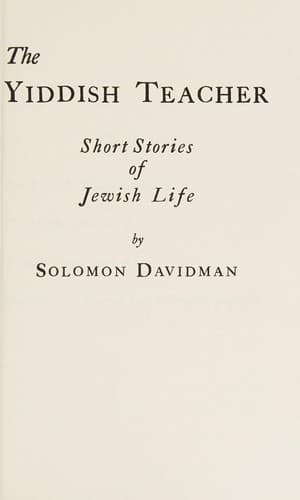
Jewish fiction; Jews -- Fiction; Short stories, Yiddish -- Translations into English; Yiddish fiction -- Translations into English
He leaned more heavily against the gate, not knowing why and not
knowing what was to come, or what would result from his standing there.
The cold grew intense, but Itsye did not feel it, for he was angry and
paid no attention to it. Besides, he had no place of refuge. Up there
in his garret it was still colder. Moreover, there was nobody there,
and he would have none upon whom to vent his wrath.
He stood thinking of nothing. It was impossible for him to think. He
no longer knew precisely that he was in a rage; it seemed to him that
today he would work a very clever piece of malice. He knew nothing
about dynamite; otherwise he would have thought unceasingly of bombs,
and would have painted himself pictures of the whole city, the whole
country, the world itself, being blown by him into atoms. But he gave
no thought to any definite project. He was certain that he would do
something malicious enough. He felt it.
Two laborers passed by and were conversing about hunting for a job.
It flashed through his head that he would stop looking for work even
if the employers starved to death! At the same time he felt that his
seeking was all in vain. He would find no work today, any more than
yesterday, or the day before, or the day before that, or the whole
twenty-seven days in which he had been searching for employment.
In his mind’s eye he could see “tomorrow,”--a dragging, cloudy day, on
which he would be faint with hunger. But he did not care to think of
tomorrow. Only “today”.... Today he must accomplish something; then he
would know what would come tomorrow, the day after, and all the other
days. Wherefore he remained leaning against the gate and looked into
the street with a cutting smile upon his pale lips and in his dull,
weary eyes, without the trace of a thought in his head. He even ceased
scolding and cursing.
All at once he tore himself away from the gate and began to walk. He
gave no heed to direction. He lost his bearings, unknown to himself. He
strode on, unaware that he was moving. His feet were like logs and he
could scarcely lift them. He became soon aware that he was no longer at
the gate, and that he was wandering about the street. Then it seemed to
him that he had wished and resolved to take a little exercise. His feet
must get warm. But he affected not to be troubled about his feet any
more than about the cold itself, which pierced him to the very marrow.
He walked along slowly, cautiously, calmly. The street on which he was
led at one end to the city-market and at the other to the municipal
garden. He had no idea of whither he was headed, but the nearer he
approached to the market the shriller and clearer became the noises
from that vicinity. Then he realized the direction in which his feet
were taking him, and again it seemed to him that this was exactly what
he had desired and determined upon. This was the very spot for him to
execute his plan of vengeance. He paused on the curb.
Public-domain text, read in full here on John Shaqi.
Reviews
Reviews
No reviews yet
Be the first to share your thoughts on this work.
Join the Discussion
Join the discussion
Sign in to leave a comment or review.
Sign InorCreate an account