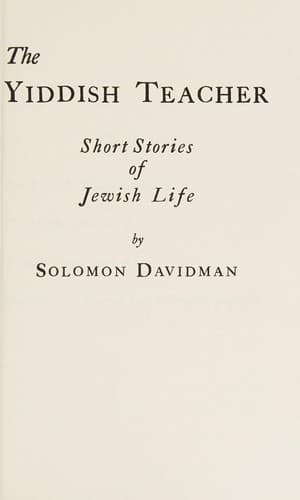
Jewish fiction; Jews -- Fiction; Short stories, Yiddish -- Translations into English; Yiddish fiction -- Translations into English
“Locked out!” flashed through his mind at once. His head became warm.
He tried to consider what was now to be done, but he saw no prospects
before him. He felt an impulse to batter down the door, enter the room,
get into bed and lie there. He had already rolled his fists into a
ball. But after striking the door a resounding blow, he ran down the
stairs. Only when he had reached the bottom did he ask himself, “Why
that blow?”
It was snowing and a strong wind was whistling and moaning. The cold
went right through Itsye’s bones; he began to tremble, and his teeth
knocked together. He huddled up in his tattered cotton coat, from which
hung patches, strips of lining and wadding. He groaned in despair and
stepped back into the entrance of the house. He felt a tug at his
heart, and was once more seized with a desire to weep, to weep.
“What will come of this? What?”
He could behold no answer. He would today be frozen to death or die of
hunger.
“Oh, for something to eat! Food, food!”
He looked about. He was standing near a cellar, the door to which was
protected by a heavy lock. He placed his hand upon the lock, with no
thought of robbery. As he felt the cold iron, however, it occurred
to him that it would be a good idea to break off the lock and obtain
access to the cellar. He pulled at the lock. No. This was beyond his
strength. He repeated the attempt, and at length summoned all his force
and gave a violent wrench.
The lock merely made a loud noise; nothing else. He was intimidated by
the knock. He looked around and quickly deserted the entrance to the
house.
Had he really desired to steal? And if he had succeeded in tearing the
lock away, would he really have entered and committed theft? He could
not believe this. He had been born into poverty; had been reared as
an orphan in misery and ill-treatment, yet his hand had never been
raised to another’s property. “Scandal-raiser,” they used to call him,
and “wickedest of the wicked”; for he never was silent when wronged,
and all were his enemies because of this vindictiveness. Yet these
self-same persons admitted that you could leave heaps of gold with him
in perfect security. And just now he had been on the point of stealing!
That morning he had also thought of stealing. What? Would he really
have stolen? And perhaps yes. Ah, he was so hungry! “Food, food, food!”
Again he surveyed the neighborhood. He was in the street! He had not
even noticed it when he left the yard. What was he going to do in the
street? Whither would he go? “Oh, for a bite!” But there was no sense
in standing here in the street. He must walk. “Walk wherever my eyes
lead me, until I fall--fall, and an end of me!”
Again his wrath returned. Anger against himself and the whole world. At
once, however, he saw that he lacked the strength to be angry--that his
heart was growing weaker. “Food, food, food!”
Public-domain text, read in full here on John Shaqi.
Reviews
Reviews
No reviews yet
Be the first to share your thoughts on this work.
Join the Discussion
Join the discussion
Sign in to leave a comment or review.
Sign InorCreate an account