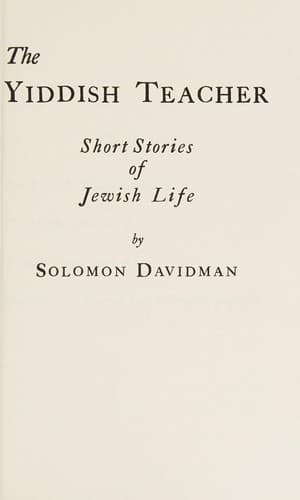
Jewish fiction; Jews -- Fiction; Short stories, Yiddish -- Translations into English; Yiddish fiction -- Translations into English
He staggered along, casting glances in every direction and knitting his
brows so as to see more clearly through the thickly falling snow. He
had no notion of whither he was going, nor was he at all interested.
He was moving so as not to remain on the same spot. He peered more
intently than ever, although he felt that he would see nothing but
large snowflakes. One thing he knew very well--that he wanted and must
have something to eat, even if the world came to an end. “Food, food,
food!” he groaned within him desperately.
He reached the municipal garden. The pleasure-spot was situated upon a
high hill, at the foot of which flowed the broad, deep river. During
the winter there was usually skating on the river, and above, in the
garden, a crowd of curious onlookers. But now there was not a trace of
human beings in the garden. Not even the lamps were visible through the
thick snow. They illuminated only the space within a few paces of them.
Itsye was at a loss whether to feel vexed or not at the absence of
people. He did not look back, and continued on his way. He approached
the top of the hill and looked down upon the frozen river. He could
see nothing. There came to his ears the shrill blows of heavy iron.
Moujiks were opening a hole in the ice. And in his weary thought he
beheld a broad, deep hole down there, and he was drawn thither. The
suggestion came to him to hurl himself down from the hill into the deep
stream. He would raise no outcry; he would not call for help. He would
drown himself quite silently. But he recognized that this was merely
a thought: the important thing was that he felt very weak and was
ravenously hungry. “Food, food, food!”
He looked about, as if he would have liked to see something eatable in
the garden. Before him was only the endlessly falling snow. Snow below
him, snow on the bare trees, snow in the air. His legs bent beneath
him--now, now he was about to fall. But he did not wish to fall. He
desired something to eat, and gathering all his strength he continued
his wanderings. Again he moved forward, not knowing whither. He walked
along a deserted path, through drifts of snow that fell into his torn
shoes--all alone, the only living creature in the dark, forsaken
garden. He could neither hear nor see anything. He moved along because
he had nowhere to go, and particularly because he wanted something to
eat, eat, eat. He thought of nothing, nor could he think if he tried.
Something was driving him on, and he continued on his way with the
despairing, inner groan, “Food, food, food!”
Public-domain text, read in full here on John Shaqi.
Reviews
Reviews
No reviews yet
Be the first to share your thoughts on this work.
Join the Discussion
Join the discussion
Sign in to leave a comment or review.
Sign InorCreate an account