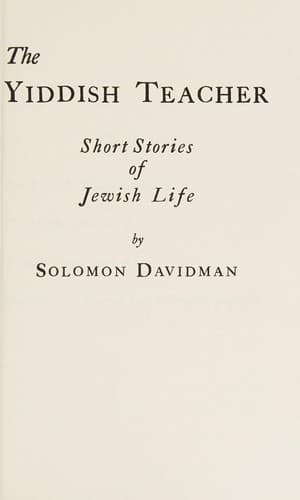
Jewish fiction; Jews -- Fiction; Short stories, Yiddish -- Translations into English; Yiddish fiction -- Translations into English
avoided the house more than he himself did. He spent most of his time
at a schoolmate’s and was rarely seen in the house. Since the oldest
brother had become a Christian he had avoided the house still more.
In this avoidance of the house the doctor saw a personal insult to
himself. “The child avoids me,” he said to himself. This made him feel
still worse and he would think: “Why does he avoid me?” And once when
he was told that Solomon had not come home for two nights (those were
the first nights after the arrival of the apostate), the doctor sought
the boy out at his friend’s and spoke to him:
“Why don’t you come home? Why do you run from the house?”
“I run from the house? It is you, father, who runs from the house,” the
boy answered boldly.
In the answer the doctor heard the whole inner truth--that he was
lonely and avoided the house which he had built up; in this answer he
heard the whole poverty, the whole forlornness of the situation in
which he found himself, and he ceased to trouble his son with further
questions.
The doctor began to take great interest in what was going on among
the Jews. He read Russo-Jewish newspapers, thought much of Jewish
interests, and found that a new Jewish life was beginning in Palestine,
that Jews were emigrating there, and becoming farmers; that there was
hope of a Jewish state being founded, where Judaism could develop
freely and frankly to a strong and rich fruition. Palestine awoke in
the doctor the memories of his childhood years, of his father, the
storekeeper in a little town. He began to remember the Jewish holidays
that his mother had always kept;--the Jewish Sabbath, when she lit
candles; the congregation in which he had prayed; the Jewish Passover,
when all in the house was so clean, and the family gathered at the
Seder. It seemed to him that all this was closely related to Palestine;
that it came from Palestine. And there, in the new Palestine this all
would show itself stronger and freer, and the greater Judaism would
begin to develop. His eyes were suddenly opened and he beheld in
Palestine the great Jewish hope, so great, so holy, that repaid Jews
for their suffering, that gave Jews the courage and the strength to
bear all pain and insult for its sake. Palestine gave compensation
for all. He remembered, as in a dream, the Bible and the pictures in
the Bible, and his father. The pious storekeeper’s life suddenly grew
more interesting to him. He saw a certain relationship between his
father, the poor, forlorn Jew in his little home town, and the heroes
of the Bible. It was Palestine that bound them together. His father,
the storekeeper, came from the same land that knew Abraham, Isaac and
Jacob. He loved the same life they loved, and had the same duties and
customs they had. But here, in exile, where he was oppressed he could
not live like the patriarchs, the tillers of the soil, the shepherds.
Here he had but the Sabbath and the Passover that the Patriarchs had;
Public-domain text, read in full here on John Shaqi.
Reviews
Reviews
No reviews yet
Be the first to share your thoughts on this work.
Join the Discussion
Join the discussion
Sign in to leave a comment or review.
Sign InorCreate an account