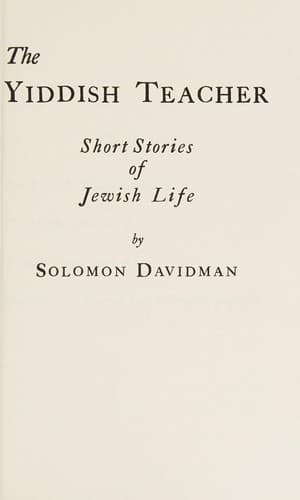
Jewish fiction; Jews -- Fiction; Short stories, Yiddish -- Translations into English; Yiddish fiction -- Translations into English
He tried to observe the Jewish holidays in his home. He himself did
not know much about them. He remembered nothing about them, and
appeared comical in his own eyes when he went out on the street to buy
Kosher meat, or bread, or matzoth and bring it home. Yet the people
in the house had taken it all very seriously; on Passover the matzoth
were placed on a serving dish, put on the table, and all were afraid
even to touch it. They all tried to be as serious about it as was he
himself--but he knew that it was a farce. No one in the house knew
anything about the holidays. The holidays they kept were the holidays
of their neighbors. Where any part of the town celebrated, the doctor’s
house celebrated with it--Easter with the Russians, Christmas with the
Catholics, but of their own holidays they knew nothing. Because of this
it was rather comical that he should all of a sudden try to celebrate
their “own” holidays.
Mainly he did it for his fourteen-year-old son, Solomon, who caused
him more unrest than all the others. He knew that the boy suffered,
that he was of a different make-up than the other children. It had
been very hard to make it possible for the boy to enter the gymnasium.
It was at a time when hate toward Jews was already raging among their
Gentile neighbors, and was more than ever in style. The boy was forced
to suffer much at the hands of his Gentile schoolmates. Often, when
he came home from school, his wet, frightened eyes seemed to ask the
terrible question: “Why?” In the beginning, when he was yet a child,
he asked his father: “Why did the Jews do that?” He was tortured so
at school, but when the doctor was unable to give him a clear, true
answer, he ceased to ask the question. Soon the child knew the full
taste of being a Jew; he grew used to it, and bore it like a grown-up,
with humility and patience. He asked no more questions, and it was seen
that he withdrew further and further into himself. He had grown very
much in the few years he spent in the gymnasium. He read serious books,
and his forehead was already wrinkled. He was quiet, and a sneering
smile towards everything and everybody lingered about his lips--the
smile of the suffering Jew towards the rest of the world. The doctor
was more ashamed of himself before the boy than before his other
children, and felt that he must do something to change the situation.
He knew the responsibility he carried in the eyes of the child: that
it was his to take care that this boy too did not become an apostate.
This drove him to think of some practical remedy. He often wanted to
speak to the youngest son about the older one’s apostasy, but he could
not. He was afraid to hear the truth from him--a thing he had heard
from none heretofore--that the fact that Mikhail turned Christian was
due more to himself than to Mikhail. He did nothing to prevent his
son from changing faith. He already read the answer in the sneering
smile that hung on the boy’s lips, and even more, in that the boy
Public-domain text, read in full here on John Shaqi.
Reviews
Reviews
No reviews yet
Be the first to share your thoughts on this work.
Join the Discussion
Join the discussion
Sign in to leave a comment or review.
Sign InorCreate an account