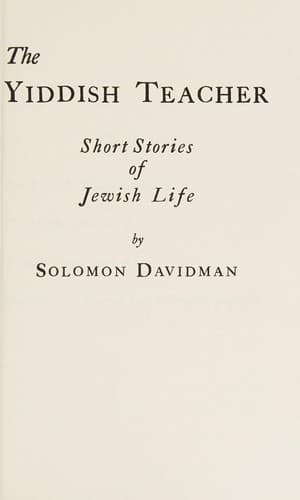
Jewish fiction; Jews -- Fiction; Short stories, Yiddish -- Translations into English; Yiddish fiction -- Translations into English
It was three hours’ ride to the border. Chayim sat the whole time at
Eda’s side, and wishing to become more intimate, he suddenly turned to
her and suggested, “I think it would help to avert suspicion on our
journey, if I were to use ‘thou’ in addressing you, and you likewise
with me.”
Having offered this short, practical suggestion he turned red, and his
heart beat wildly, as he waited for her approval.
“I really am in doubt,” she hesitated. “In high society man and wife
use ‘you’ in addressing each other.”
“But that might arouse suspicion in our case--I mean, that ‘thou’ would
be more to our purpose,” urged Chayim.
She finally consented.
Unfortunately, however, Chayim could find no opportunity for using the
coveted familiar pronoun. At last the longed-for chance arrived. He was
gazing out of the window. The sun, like a blood-red disc, was setting
behind a thick forest, gilding the tree-tops with its dying splendor.
Chayim, entranced by the scene, cried out, “Just see, Eda, see thou,
how beautiful!”
Eda arose and looked through the window. “Wonderful!” she exclaimed.
Chayim was right beside her, but instead of looking at the beautiful
sunset he sought to penetrate Eda Sandrovitch’s face, and he grew sad.
A moment later and the sun had sunk beneath the horizon, as if the
black forest had engulfed it.
They sat down and Eda began: “You know--”
“Thou knowest,” corrected Chayim. “We might betray ourselves.”
“Don’t worry on that score,” she replied, stubbornly. “You know that
we’re almost at the border.”
“We should be all the more careful for that very reason. So then, what
dost thou say, Eda?”
Eda smiled good-naturedly, replying, “If you desire to play the game,
by all means, with the greatest of pleasure!” And then, more playfully,
she added, “I say, my dear Sandrovitch, we’re soon at the border.”
“What of that, darling Eda?” He smiled in return, clasping her velvety
little hand.
She did not withdraw her hand. This made Chayim bolder. He pressed
closer to her, ever so close, and whispered tenderly, “What a sweet,
darling child thou art!”
She gazed at him with her large black eyes, in silence.
At last they pulled into Alexandrovna, the border station. The train
suddenly became alive with nervous activity. A tall gendarme with
forbidding mustache entered, crying out in official tones, “Passports!”
Chayim Grossman pulled out his passport and gave it to the gendarme.
“And you?” asked the latter in Russian, turning to Eda.
“She is my wife,” answered Chayim, in the same language.
“Very well,” was the response, as if approving the match. Chayim felt
distinctly flattered with the approval.
The gendarme collected the passports of the other occupants and then
left, locking the door of the coach.
“And now we are in very truth man and wife,” whispered Chayim
passionately to Eda.
“Yes, of course,” Eda nodded.
Her acquiescence made Chayim very happy, and he turned boldly to her,
asking tenderly, “Wouldst thou have a bite to eat?”
Public-domain text, read in full here on John Shaqi.
Reviews
Reviews
No reviews yet
Be the first to share your thoughts on this work.
Join the Discussion
Join the discussion
Sign in to leave a comment or review.
Sign InorCreate an account