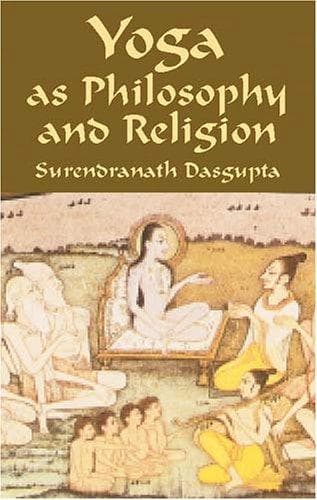
Yoga as philosophy and religionDasgupta, Surendranath
Religion
Yoga as philosophy and religion
Dasgupta, Surendranath
Hindu philosophy; Patañjali; Yoga
But it is easy to see that ordinary minds can never commence with these
practices. They are naturally so impure that the positive universal
sympathy as manifested in maitrī, etc., by which turbidity of mind is
removed, is too difficult. It is also difficult for them to keep the
mind steady on an object as in dhāraṇā, dhyāna, and samādhi, for only
those in advanced stages can succeed in this. For ordinary people,
therefore, some course of conduct must be discovered by which they can
purify their minds and elevate them to such an extent that they may be
in a position to avail themselves of the mental parikarmas or
purifications just mentioned. Our minds become steady in proportion as
their impurities are cleansed. The cleansing of impurities only
represents the negative aspect of the positive side of making the mind
steady. The grosser impurities being removed, finer ones remain, and
these are removed by the mental parikarmas, supplemented by abhyāsa or
by śraddhā, etc. As the impurities are gradually more and more
attenuated, the last germs of impurity are destroyed by the force of
dhyāna or the habit of nirodha samādhi, and kaivalya is attained.
We now deal with yamas, by which the gross impurities of ordinary minds
are removed. They are, as we have said before, non-injury, truthfulness,
non-stealing, continence, and non-covetousness; of these non-injury is
given such a high place that it is regarded as the root of the other
yamas; truthfulness, non-stealing, continence, non-covetousness and the
other niyamas mentioned previously only serve to make the non-injury
perfect. We have seen before that maitrī, karuṇa, muditā and upekshā
serve to strengthen the non-injury since they are only its positive
aspects, but we see now that not only they but other yamas and also the
other niyamas, purity, contentment, asceticism, studies and devotion to
God, only serve to make non-injury more and more perfect. This
non-injury when it is performed without being limited or restricted in
any way by caste, country, time and circumstances, and is always adhered
to, is called mahāvrata or the great duty of abstinence from injury. It
is sometimes limited to castes, as for example injury inflicted by a
fisherman, and in this case it is called anuvrata or restricted ahiṃsā
of ordinary men as opposed to universal ahiṃsā of the Yogins called
mahāvrata; the same non-injury is limited by locality, as in the case of
a man who says to himself, “I shall not cause injury at a sacred place”;
or by time, when a person says to himself, “I shall not cause injury on
the sacred day of Caturdaśī”; or by circumstances, as when a man says to
himself, “I shall cause injury for the sake of gods and Brahmans only”;
or when injury is caused by warriors in the battle-field alone and
nowhere else. This restricted ahiṃsā is only for ordinary men who cannot
follow the Yogin’s universal law of ahiṃsā.
Public-domain text, read in full here on John Shaqi.
Reviews
Reviews
No reviews yet
Be the first to share your thoughts on this work.
Elsewhere in the archive
Join the Discussion
Join the discussion
Sign in to leave a comment or review.
Sign InorCreate an account