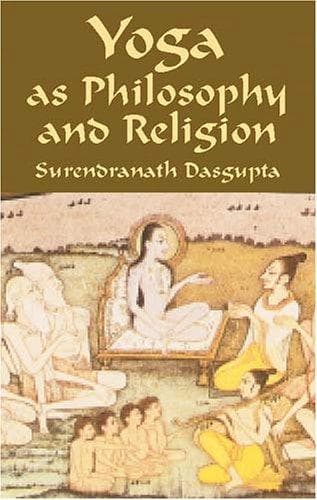
Yoga as philosophy and religionDasgupta, Surendranath
Religion
Yoga as philosophy and religion
Dasgupta, Surendranath
Hindu philosophy; Patañjali; Yoga
If, in performing the great duty of non-injury and the other virtues
auxiliary to it, a man be troubled by thoughts of sin, he should try to
remove sinful ideas by habituating himself to those which are contrary
to them. Thus if the old habit of sins opposed to virtues tend to drive
him along the wrong path, he should in order to banish them entertain
ideas such as the following:—“Being burnt up as I am in the fires of the
world, I have taken refuge in the practice of Yoga which gives
protection to all living beings. Were I to resume the sins which I have
abandoned, I should certainly be behaving like a dog, which eats its own
vomit. As the dog takes up his own vomit, so should I be acting if I
were to take up again what I have once given up.” This is called the
practice of _pratipaksha bhāvān_, meditating on the opposites of the
temptations.
A classification of sins of non-injury, etc., may be made according as
they are actually done, or caused to be done, or permitted to be done;
and these again may be further divided according as they are preceded by
desire, anger or ignorance; these are again mild, middling or intense.
Thus we see that there may be twenty-seven kinds of such sins. Mild,
middling and intense are each again threefold, mild-mild, mild-middling
and mild-intense; middling-mild, middling-middling and middling-intense;
also intense-mild, intense-middling and intense-intense. Thus there are
eighty-one kinds of sins. But they become infinite on account of rules
of restriction, option and conjunction.
The contrary tendency consists in the notion that these immoral
tendencies cause an infinity of pains and untrue knowledge. Pain and
unwisdom are the unending fruits of these immoral tendencies, and in
this idea lies the power which produces the habit of giving a contrary
trend to our thoughts.
These yamas, together with the niyamas about to be described, are called
kriyāyoga, by the performance of which men become fit to rise gradually
to the state of jñānayoga by samādhi and to attain kaivalya. This course
thus represents the first stage with which ordinary people should begin
their Yoga work.
Those more advanced, who naturally possess the virtues mentioned in
Yama, have no need of beginning here.
Thus it is said that some may begin with the niyamas, asceticism,
svādhyāya and devotion to God; it is for this reason that, though
mentioned under the niyamas, they are also specially selected and spoken
of as the kriyāyoga in the very first rule of the second Book.
Asceticism means the strength of remaining unchanged in changes like
that of heat and cold, hunger and thirst, standing and sitting, absence
of speech and absence of all indications by gesture, etc.
Svādhyāya means the study of philosophy and repetition of the syllable
“Aum.”
Public-domain text, read in full here on John Shaqi.
Reviews
Reviews
No reviews yet
Be the first to share your thoughts on this work.
Elsewhere in the archive
Join the Discussion
Join the discussion
Sign in to leave a comment or review.
Sign InorCreate an account