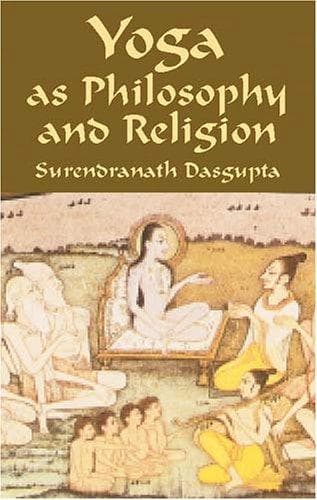
Yoga as philosophy and religionDasgupta, Surendranath
Religion
Yoga as philosophy and religion
Dasgupta, Surendranath
Hindu philosophy; Patañjali; Yoga
This Īśvarapraṇidhāna (devotion to God) is different from the
Īśvarapraṇidhāna mentioned in _Yoga-sūtra_, I. 23, where it meant love,
homage and adoration of God, by virtue of which God by His grace makes
samādhi easy for the Yogin.
Here it is a kind of kriyāyoga, and hence it means the bestowal of all
our actions upon the Great Teacher, God, i.e. to work, not for one’s own
self but for God, so that a man desists from all desires for fruit
therefrom.
When these are duly performed, the afflictions become gradually
attenuated and trance is brought about. The afflictions thus attenuated
become characterised by unproductiveness, and when their seed-power has,
as it were, been burnt up by the fire of high intellection and the mind
untouched by afflictions realises the distinct natures of purusha and
sattva, it naturally returns to its own primal cause prakṛti and
kaivalya is attained.
Those who are already far advanced do not require even this kriyāyoga,
as their afflictions are already in an attenuated state and their minds
in a fit condition to adapt themselves to samādhi; they can therefore
begin at once with jñānayoga. So in the first chapter it is with respect
to these advanced men that it is said that kaivalya can be attained by
abhyāsa and vairāgya, without adopting the kriyāyoga (_Yoga-vārttika_,
II. 2) kriyāyogas. Only śauca and santosha now remain to be spoken of.
Śauca means cleanliness of body and mind. Cleanliness of body is brought
about by water, cleanliness of mind by removal of the mental impurities
of pride, jealousy and vanity.
Santosha (contentment) is the absence of desire to possess more than is
necessary for the preservation of one’s life. It should be added that
this is the natural result of ceasing to desire to appropriate the
property of others.
At the close of this section on the yamas and niyamas, it is best to
note their difference, which lies principally in this that the former
are the negative virtues, whereas the latter are positive. The former
can, and therefore must, be practised at all stages of Yoga, whereas the
latter being positive are attainable only by distinct growth of mind
through Yoga. The virtues of non-injury, truthfulness, sex restraint,
etc., should be adhered to at all stages of the Yoga practice. They are
indispensable for steadying the mind.
It is said that in the presence of a person who has acquired steadiness
in ahiṃsā all animals give up their habits of enmity; when a person
becomes steady in truthfulness, whatever he says becomes fulfilled. When
a person becomes steady in asteya (absence of theft) all jewels from all
quarters approach him.
Continence being confirmed, vigour is obtained. Non-covetousness being
confirmed, knowledge of the causes of births is attained. By steadiness
of cleanliness, disinclination to this body and cessation of desire for
other bodies is obtained.
Public-domain text, read in full here on John Shaqi.
Reviews
Reviews
No reviews yet
Be the first to share your thoughts on this work.
Elsewhere in the archive
Join the Discussion
Join the discussion
Sign in to leave a comment or review.
Sign InorCreate an account