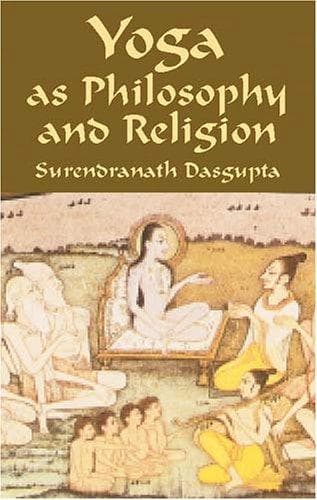
Yoga as philosophy and religionDasgupta, Surendranath
Religion
Yoga as philosophy and religion
Dasgupta, Surendranath
Hindu philosophy; Patañjali; Yoga
When the mind attains internal śauca, or cleanliness of mind, his sattva
becomes pure, and he acquires highmindedness, one-pointedness, control
of the senses and fitness for the knowledge of self. By the steadiness
of contentment comes the acquisition of extreme happiness. By steadiness
of asceticism the impurities of this body are removed, and from that
come miraculous powers of endurance of the body and also miraculous
powers of the sense, viz. clairaudience and thought-reading from a
distance. By steadiness of studies the gods, the ṛshis and the siddhas
become visible. When Īśvara is made the motive of all actions, trance is
attained. By this the Yogin knows all that he wants to know, just as it
is in reality, whether in another place, another body or another time.
His intellect knows everything as it is.
It should not, however, be said, says Vācaspati, that inasmuch as the
saṃprajñāta is attained by making Īśvara the motive of all actions, the
remaining seven yogāṅgas are useless. For the yogāṅgas are useful in the
attainment of that mental mood which devotes all actions to the purposes
of Īśvara. They are also useful in the attainment of saṃprajñāta samādhi
by separate kinds of collocations, and samādhi also leads to the
fruition of saṃprajñāta, but though this meditation on Īśvara is itself
a species of Īśvarapraṇidhāna, saṃprajñāta Yoga is a yet more direct
means. As to the relation of Īśvarapraṇidhāna with the other aṅgas of
Yoga, Bhikshu writes:—It cannot be asked what is the use of the other
disciplinary practices of the Yoga since Yoga can be attained by
meditation on Īśvara, for meditation on Īśvara only removes ignorance.
The other accessories bring about samādhi by their own specific modes of
operation. Moreover, it is by help of meditation on Īśvara that one
succeeds in bringing about samādhi, through the performance of all the
accessories of Yoga; so the accessories of Yoga cannot be regarded as
unnecessary; for it is the accessories which produce dhāraṇa, dhyāna and
samādhi, through meditation on God, and thereby salvation; devotion to
God brings in His grace and through it the yogāṅgas can be duly
performed. So though devotion to God may be considered as the direct
cause, it cannot be denied that the due performance of the yogāṅgas is
to be considered as the indirect cause.
Āsanas are secured when the natural involuntary movements cease, and
this may be effected by concentrating the mind on the mythological snake
which quietly bears the burden of the earth on its head. Thus posture
becomes perfect and effort to that end ceases, so that there is no
movement of the body; or the mind is transformed into the infinite,
which makes the idea of infinity its own and then brings about the
perfection of posture. When posture has once been mastered there is no
disturbance through the contraries of heat and cold, etc.
Public-domain text, read in full here on John Shaqi.
Reviews
Reviews
No reviews yet
Be the first to share your thoughts on this work.
Elsewhere in the archive
Join the Discussion
Join the discussion
Sign in to leave a comment or review.
Sign InorCreate an account