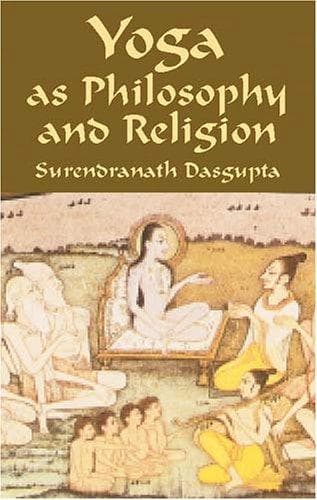
Yoga as philosophy and religionDasgupta, Surendranath
Religion
Yoga as philosophy and religion
Dasgupta, Surendranath
Hindu philosophy; Patañjali; Yoga
But as Bhikshu points out (_Yoga-vārttika_, II. 18) this prakṛti is
not simple substance, for it is but the guṇa reals. It is simple only
in the sense that no complex qualities are manifested in it. It is the
name of the totality of the guṇa reals existing in a state of
equilibrium through their mutual counter opposition. It is a
hypothetical state of the guṇas preceding the states in which they
work in mutual co-operation for the creation of the cosmos for giving
the purushas a chance for ultimate release attained through a full
enjoyment of experiences. Some European scholars have often asked me
whether the prakṛti were real or whether the guṇas were real. This
question, in my opinion, can only arise as a result of confusion and
misapprehension, for it is the guṇas in a state of equilibrium that
are called prakṛti. Apart from guṇas there is no prakṛti (_guṇā eva
prakṛtiśabdavācyā na tu tadatiriktā prakṛtirasti. Yoga-vārttika_, II.
18). In this state, the different guṇas only annul themselves and no
change takes place, though it must be acknowledged that the state of
equipoise is also one of tension and action, which, however, being
perfectly balanced does not produce any change. This is what is meant
by evolution of similars (_adṛśapariṇāma_). Prakṛti as the equilibrium
of the three guṇas is the absolute ground of all the mental and
phenomenal modifications—pure potentiality.
Veṅkaṭa, a later Vaishṇava writer, describes prakṛti as one ubiquitous,
homogeneous matter which evolves itself into all material productions by
condensation and rarefaction. In this view the guṇas would have to be
translated as three different classes of qualities or characters, which
are found in the evolutionary products of the prakṛti. This will of
course be an altogether different view of the prakṛti from that which is
described in the _Vyāsa-bhāshya_, and the guṇas could not be considered
as reals or as substantive entities in such an interpretation. A
question arises, then, as to which of these two prakṛtis is the earlier
conception. I confess that it is difficult to answer it. For though the
Vaishṇava view is elaborated in later times, it can by no means be
asserted that it had not quite as early a beginning as 2nd or 3rd
century B.C. If _Ahirbudhnyasamhitā_ is to be trusted then the
_Shashṭitantraśāstra_ which is regarded as an authoritative Sāṃkhya work
is really a Vaishṇava work. Nothing can be definitely stated about the
nature of prakṛti in Sāṃkhya from the meagre statement of the _Kārikā_.
The statement in the _Vyāsa-bhāshya_ is, however, definitely in favour
of the interpretation that we have adopted, and so also the
_Sāṃkhya-sūtra_, which is most probably a later work. Caraka’s account
of prakṛti does not seem to be the prakṛti of _Vyāsa-bhāshya_ for here
the guṇas are not regarded as reals or substantive entities, but as
characters, and prakṛti is regarded as containing its evolutes, mahat,
etc., as its elements (_dhātu_).
Public-domain text, read in full here on John Shaqi.
Reviews
Reviews
No reviews yet
Be the first to share your thoughts on this work.
Join the Discussion
Join the discussion
Sign in to leave a comment or review.
Sign InorCreate an account