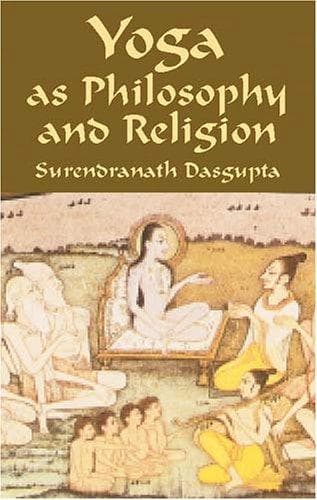
Yoga as philosophy and religionDasgupta, Surendranath
Religion
Yoga as philosophy and religion
Dasgupta, Surendranath
Hindu philosophy; Patañjali; Yoga
Vācaspati again says:—“The fulfilment of the objects of the purusha
could be said to be the cause of the original state, if that state could
bring about the fulfilment of the objects of the purusha, such as the
enjoyment of sound, etc., or manifest the discrimination of the
distinction between true self and other phenomena. If however it did
that, it could not be a state of equilibrium,” (_yadyaliṅgāvasthā
śabdādyupabhogam vā sattvapurushānyatākhyātim vā purushārtham
nirvarttayet tannrvarttane hi na sāmyavasthā syāt_). This state is
called the prakṛti. It is the beginning, indeterminate, unmediated and
undetermined. It neither exists nor does it not exist, but is the
principium of almost all existence. Thus Vyāsa describes it as “the
state which neither is nor is not; that which exists and yet does not;
that in which there is no non-existence; the unmanifested, the noumenon
(lit. without any manifested indication), the background of all”
(_niḥsattāsattam niḥsadasat nirasat avyaktam aliṅgam pradhānam_).[10]
Vācaspati explains it as follows:—“Existence consists in possessing the
capacity of effecting the fulfilment of the objects of the purusha.
Non-existence means a mere imaginary trifle (e.g. the horn of a hare).”
It is described as being beyond both these states of existence and
non-existence. The state of the equipoise of the three guṇas of
intelligence-stuff, inertia and energy, is nowhere of use in fulfilling
the objects of the purusha. It therefore does not exist as such. On the
other hand, it does not admit of being rejected as non-existent like an
imaginary lotus of the sky. It is therefore not non-existent. But even
allowing the force of the above arguments about the want of phenomenal
existence of prakṛti on the ground that it cannot serve the objects of
the purusha, the difficulty arises that the principles of Mahat, etc.,
exist in the state of the unmanifested also, because nothing that exists
can be destroyed; and if it is destroyed, it cannot be born again,
because nothing that does not exist can be born; it follows therefore
that since the principles of mahat, etc., exist in the state of the
unmanifested, that state can also affect the fulfilment of the objects
of the purusha. How then can it be said that the unmanifested is not
possessed of existence? For this reason, he describes it as that in
which it exists and does not exist. This means that the cause exists in
that state in a potential form but not in the form of the effect.
Although the effect exists in the cause as mere potential power, yet it
is incapable of performing the function of fulfilling the objects of the
purusha; it is therefore said to be non-existent as such. Further he
says that this cause is not such, that its effect is of the nature of
hare’s horn. It is beyond the state of non-existence, that is, of the
existence of the effect as mere nothing. If it were like that, then it
would be like the lotus of the sky and no effect would follow.[11]
Public-domain text, read in full here on John Shaqi.
Reviews
Reviews
No reviews yet
Be the first to share your thoughts on this work.
Join the Discussion
Join the discussion
Sign in to leave a comment or review.
Sign InorCreate an account