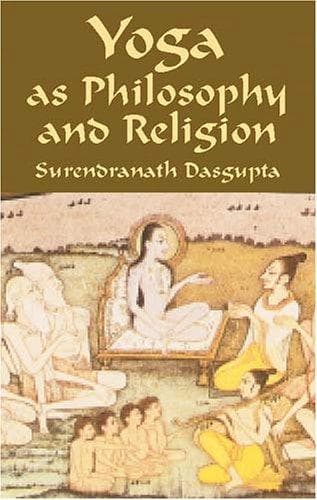
Yoga as philosophy and religionDasgupta, Surendranath
Religion
Yoga as philosophy and religion
Dasgupta, Surendranath
Hindu philosophy; Patañjali; Yoga
Samādhi we have seen is the mind’s becoming one with an object by a
process of acute concentration upon it and a continuous repetition of it
with the exclusion of all other thoughts of all kinds. We have indeed
described the principal stages of the advancement of samprajñāta Yoga,
but it is impossible to give an exact picture of it with the symbolical
expressions of our concepts; for the stages only become clear to the
mental vision of the Yogin as he gradually acquires firmness in his
practice. The Yogin who is practising at once comes to know them as the
higher stages gradually dawn in his mind and he distinguishes them from
each other; it is thus a matter of personal experience, so that no
teacher can tell him whether a certain stage which follows is higher or
lower, for Yoga itself is its own teacher.
Even when the mind is in the samprajñāta state it is said to be in
vyutthāna (phenomenal) in comparison with the nirodha state, just as the
ordinary conscious states are called vyutthāna in comparison with the
samprajñāta state; the potencies of the samprajñāta state become weaker
and weaker, while the potencies of the nirodha state become stronger and
stronger until finally the mind comes to the nirodha state and becomes
stable therein; of course this contains within itself a long mental
history, for the potency of the nirodha state can become stronger only
when the mind practises it and remains in this suppressed condition for
long intervals of time. This shows that the mind, being made up of the
three guṇas, is always suffering transformations and changes. Thus from
the ordinary state of phenomenal consciousness it gradually becomes
one-pointed and then gradually becomes transformed into the state of an
object (internal or external), when it is said to be undergoing the
samādhi pariṇāma or samādhi change of the samprajñāta type; next comes
the change, when the mind passes from the samprajñāta stage to the state
of suppression (_nirodha_). Here also, therefore, we see that the same
dharma, lakshṇa, avasthāpariṇāma which we have already described at some
length with regard to sensible objects apply also to the mental states.
Thus the change from the vyutthāna (ordinary experience) to the nirodha
state is the dharmapariṇāma, the change as manifested in time, so that
we can say that the change of vyutthāna into nirodha has not yet come,
or has just come, or that the vyutthāna state (ordinary experience)
exists no longer, the mind having transformed itself into the nirodha
state. There is also here the third change of condition, when we see
that the potencies of the samprajñāta state become weaker and weaker,
while that of the nirodha state becomes stronger and stronger. These are
the three kinds of change which the mind undergoes called the dharma,
lakshaṇa and avasthā change. But there is one difference between this
change thus described from the changes observed in sensible objects that
Public-domain text, read in full here on John Shaqi.
Reviews
Reviews
No reviews yet
Be the first to share your thoughts on this work.
Elsewhere in the archive
Join the Discussion
Join the discussion
Sign in to leave a comment or review.
Sign InorCreate an account