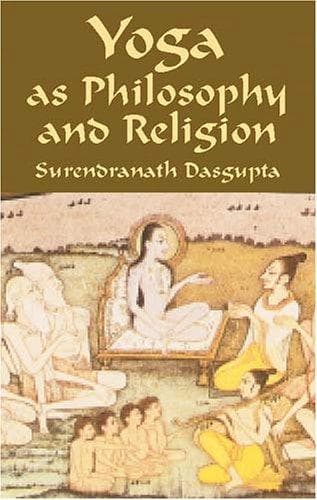
Yoga as philosophy and religionDasgupta, Surendranath
Religion
Yoga as philosophy and religion
Dasgupta, Surendranath
Hindu philosophy; Patañjali; Yoga
The third aspect is the aspect of tanmātras, which are the causes of the
atoms or paramāṇus. Their fourth aspect is their aspect of guṇas or
qualities of illumination, action, inertia. Their fifth aspect is that
by which they are serviceable to purusha, by causing his pleasurable or
painful experiences and finally his liberation.
Speaking of aggregation with regard to the structure of matter, we see
that this is of two kinds (1) when the parts are in intimate union and
fusion, e.g. any vegetable or animal body, the parts of which can never
be considered separately. (2) When there are such mechanical aggregates
or collocations of distinct and independent parts _yutasiddhāvayava_ as
the trees in a forest.
A dravya or substance is an aggregate of the former type, and is the
grouping of generic or specific qualities and is not a separate
entity—the abode of generic and specific qualities like the dravya of
the Vaiśeshika conception. The aspect of an unification of generic and
specific qualities seen in parts united in intimate union and fusion is
called the dravya aspect. The aggregation of parts is the structural
aspect of which the side of appearance is the unification of generic and
specific qualities called the dravya.
The other aggregation of yutasiddhāvayava, i.e. the collocation of the
distinct and independent parts, is again of two kinds, (1) in which
stress may be laid on the distinction of parts, and (2) that in which
stress is laid on their unity rather than on their distinctness. Thus in
the expression mango-grove, we see that many mangoes make a grove, but
the mangoes are not different from the grove. Here stress is laid on the
aspect that mangoes are the same as the grove, which, however, is not
the case when we say that here is a grove of mangoes, for the expression
“grove of mangoes” clearly brings home to our minds the side of the
distinct mango-trees which form a grove.
Of the gross elements, ākāśa seems especially to require a word of
explanation. There are according to Vijñāna Bhikshu and Nāgeśa two kinds
of ākāśa—kāraṇa (or primal) and kārya (atomic). The first or original is
the undifferentiated formless tamas, for in that stage it has not the
quality of manifesting itself in sounds. This kāraṇa later on develops
into the atomic ākāśa, which has the property of sound. According to the
conception of the purāṇas, this karyākāśa evolves from the ego as the
first envelope of vāyu or air. The kāraṇakāśa or non-atomic ākāśa should
not be considered as a mere vacuum, but must be conceived as a positive,
all-pervasive entity, something like the ether of modern physicists.
Public-domain text, read in full here on John Shaqi.
Reviews
Reviews
No reviews yet
Be the first to share your thoughts on this work.
Elsewhere in the archive
Join the Discussion
Join the discussion
Sign in to leave a comment or review.
Sign InorCreate an account