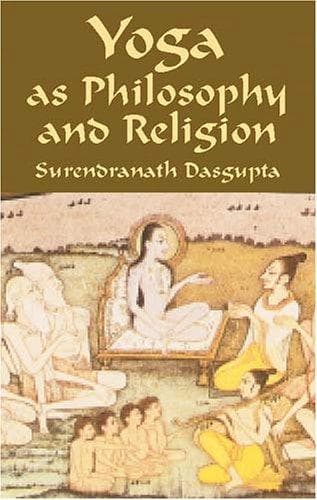
Yoga as philosophy and religionDasgupta, Surendranath
Religion
Yoga as philosophy and religion
Dasgupta, Surendranath
Hindu philosophy; Patañjali; Yoga
From this ākāśa springs the atomic ākāśa or kāryākāśa, which is the
cause of the manifestation of sound. All powers of hearing, even though
they have their origin in the principle of egoism, reside in the ākāśa
placed in the hollow of the ear. When soundness or defect is noticed
therein, soundness or defect is also noticed in the power of hearing.
Further, when of the sounds working in unison with the power of hearing,
the sounds of solids, etc., are to be apprehended, then the power of
hearing located in the hollow of the ear requires the capacity of
resonance residing in the substratum of the ākāśa of the ear. This sense
of hearing, then, operates when it is attracted by the sound originated
and located in the mouth of the speaker, which acts as a loadstone. It
is this ākāśa which gives penetrability to all bodies; in the absence of
this, all bodies would be so compact that it would be difficult to
pierce them even with a needle. In the _Sāṃkhya-sūtra_ II. 12, it is
said that eternal time and space are of the nature of ākāśa. So this
so-called eternal time and space do not differ from the one
undifferentiated formless tamas of which we have just spoken. Relative
and infinite time arise from the motion of atoms in space—the cause of
all change and transformation; and space as relative position cannot be
better expressed than in the words of Dr. B. N. Seal, as “totality of
positions as an order of co-existent points, and as such it is wholly
relative to the understanding like order in time, being constructed on
the basis of relations of position intuited by our empirical or relative
consciousness. But there is this difference between space order and time
order:—there is no unit of space as position (_dik_) though we may
conceive time, as the moment (_kshaṇa_) regarded as the unit of change
in the causal series. Spatial position (_dik_) results only from the
different relations in which the all-pervasive ākāśa stands to the
various finite objects. On the other hand, space as extension or locus
of a finite body, or deśa, has an ultimate unit, being analysable into
the infinitesimal extension quality inherent in the guṇas of
prakṛti.”[44]
Public-domain text, read in full here on John Shaqi.
Reviews
Reviews
No reviews yet
Be the first to share your thoughts on this work.
Elsewhere in the archive
Join the Discussion
Join the discussion
Sign in to leave a comment or review.
Sign InorCreate an account