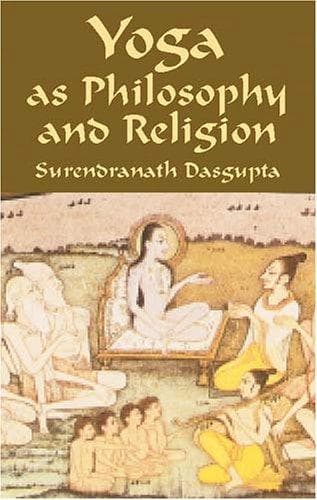
Yoga as philosophy and religionDasgupta, Surendranath
Religion
Yoga as philosophy and religion
Dasgupta, Surendranath
Hindu philosophy; Patañjali; Yoga
Citta or mind has two degrees: (1) the form of states such as real
cognition, including perception, inference, competent evidence, unreal
cognition, imagination, sleep and memory. (2) In the form in which all
those states are suppressed. Between the stage of complete outgoing
activity of ordinary experience (_vyutthāna_) and complete suppression
of all states, there are thousands of states of infinite variety,
through which a man’s experiences have to pass, from the vyutthāna state
to the nirodha. In addition to the five states spoken of above, there is
another kind of real knowledge and intuition, called prajñā, which dawns
when by concentration the citta is fixed upon any one state and that
alone. This prajñā is superior to all other means of knowledge, whether
perception, inference or competent evidence of the Vedas, in this, that
it is altogether unerring, unrestricted and unlimited in its scope.
Pramāṇa, we have seen, includes perception, inference and competent
evidence. Perception originates when the mind or citta, through the
senses (ear, skin, eye, taste and nose) is modified by external objects
and passes to them, generating a kind of knowledge about them in which
their specific characters become more predominant.
Mind is all-pervasive and can come in touch with the external world, by
which we have the perception of the thing. Like light, which emits rays
and pervades all, though it remains in one place, the citta by its
vṛttis comes in contact with the external world, is changed into the
form of the object of perception and thus becomes the cause of
perception; as the citta has to pass through the senses, it becomes
coloured by them, which explains the fact that perception is impossible
without the help of the senses. As it has to pass through the senses, it
undergoes the limitations of the senses, which it can avoid, if it can
directly concentrate itself upon any object without the help of the
senses; from this originates the prajñā, through which dawns absolute
real knowledge of the thing; unhampered by the limitations of the senses
which can act only within a certain area or distance and cannot cognize
subtler objects.
We see that in ordinary perception our minds are drawn towards the
object, as iron is attracted by magnets. Thus Bhikshu says in explaining
_Vyāsa-bhāshya_ IV. 17:—
“The objects of knowledge, though inactive in themselves, may yet draw
the everchanging cittas towards them like a magnet and change them in
accordance with their own forms, just as a piece of cloth is turned red
by coming into contact with red lac.” So it is that the cittas attain
the form of anything with which they come in touch and there is then the
perception that that thing is known. Perception (_pratyaksha_) is
distinguished from inference, etc., in this, that here the knowledge
arrived at is predominantly of the specific and special characters
(_viśesha_) of the thing and not of its generic qualities us in
inference, etc.
Public-domain text, read in full here on John Shaqi.
Reviews
Reviews
No reviews yet
Be the first to share your thoughts on this work.
Elsewhere in the archive
Join the Discussion
Join the discussion
Sign in to leave a comment or review.
Sign InorCreate an account