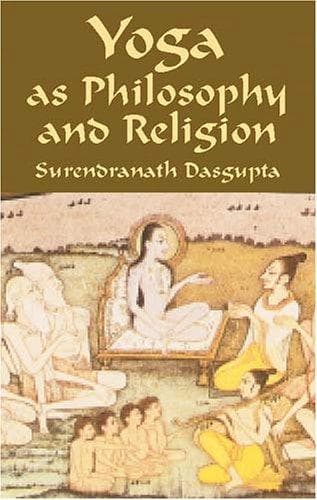
Yoga as philosophy and religionDasgupta, Surendranath
Religion
Yoga as philosophy and religion
Dasgupta, Surendranath
Hindu philosophy; Patañjali; Yoga
Inference proceeds from inference, and depends upon the fact that
certain common qualities are found in all the members of a class, as
distinguished from the members of a different class. Thus the qualities
affirmed of a class will be found to exist in all the individual members
of that class; this attribution of the generic characters of a class to
the individual members that come under it is the essence of inference.
An object perceived or inferred by a competent man is described by him
in words with the intention of transferring his knowledge to another;
and the mental modification, which has for its sphere the meaning of
such words, is the verbal cognition of the hearer. When the speaker has
neither perceived nor inferred the object, and speaks of things which
cannot be believed, the authority of verbal cognition fails. But it does
not fail in the original speaker, God or Īśvara, and his dictates the
Śāstras with reference either to the object of perception or of
inference.
Viparyyaya or unreal cognition is the knowledge of the unreal as in
doubt—a knowledge which possesses a form that does not tally with the
real nature of the thing either as doubt or as false knowledge. Doubt
may be illustrated by taking the case of a man who sees something in dim
light and doubts its nature. “Is it a wooden post or a man?” In nature
there is either the wooden post or the man, but there is no such fact or
entity which corresponds with doubt: “Is it a wooden post or a man?”
Knowledge as doubt is not cognition of a fact or entity. The illusion of
seeing all things yellow through a defect of the eye (as in jaundice)
can only be corrected when the objects are seen in their true colours.
In doubt, however, their defective nature is at once manifest. Thus when
we cannot be sure whether a certain thing is a post or a man, we know
that our knowledge is not definite. So we have not to wait till the
illusoriness of the previous knowledge is demonstrated by the advent of
right knowledge. The evil nature of viparyyaya is exemplified in avidyā
nescience, asmitā, rāga, etc.[45]
Viparyyaya is distinguished from vikalpa—imagination—in this, that
though the latter is also unreal knowledge its nature as such is not
demonstrated by any knowledge that follows, but is on the contrary
admitted on all sides by the common consent of mankind. But it is only
the learned who can demonstrate by arguments the illusoriness of vikalpa
or imagination.
Public-domain text, read in full here on John Shaqi.
Reviews
Reviews
No reviews yet
Be the first to share your thoughts on this work.
Elsewhere in the archive
Join the Discussion
Join the discussion
Sign in to leave a comment or review.
Sign InorCreate an account