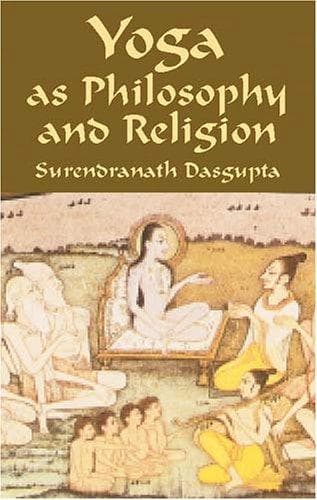
Yoga as philosophy and religionDasgupta, Surendranath
Religion
Yoga as philosophy and religion
Dasgupta, Surendranath
Hindu philosophy; Patañjali; Yoga
All class notions and concepts are formed by taking note only of the
general characters of things and associating them with a symbol called
“name.” Things themselves, however, do not exist in the nature of these
symbols or names or concepts; it is only an aspect of them that is
diagrammatically represented by the intellect in the form of concepts.
When concepts are united or separated in our thought and language, they
consequently represent only an imaginary plane of knowledge, for the
things are not as the concepts represent them. Thus when we say
“Caitra’s cow,” it is only an imaginary relation for, strictly speaking,
no such thing exists as the cow of Caitra. Caitra has no connection in
reality with the cow. When we say purusha is of the nature of
consciousness, there is the same illusory relation. Now what is here
predicated of what? Purusha is consciousness itself, but in predication
there must always be a statement of the relation of one to another. Thus
it sometimes breaks a concept into two parts and predicates the one of
the other, and sometimes predicates the unity of two concepts which are
different. Thus its sphere has a wide latitude in all thought-process
conducted through language and involves an element of abstraction and
construction which is called vikalpa. This represents the faculty by
which our concepts are arranged in an analytical or synthetical
proposition. It is said to be _śabdajñānānupāti vastuśūnyo vikalpaḥ_,
i.e. the knowledge that springs from relating concepts or names, which
relating does not actually exist in the objective world as it is
represented in propositional forms.
Sleep is that mental state which has for its objective substratum the
feeling of emptiness. It is called a state or notion of mind, for it is
called back on awakening; when we feel that we have slept well our minds
are clear, when we have slept badly our minds are listless, wandering
and unsteady. For a person who seeks to attain communion or samādhi,
these desires of sleep are to be suppressed, like all other desires.
Memory is the retaining in the mind of objects perceived when perception
occurs by the union of the cittas with external objects, according to
the forms of which the cittas are transformed; it retains these
perceptions, as impressions or saṃskāras by means of its inherent tamas.
These saṃskāras generate memory, when such events occur as can manifest
them by virtue of associations.
Public-domain text, read in full here on John Shaqi.
Reviews
Reviews
No reviews yet
Be the first to share your thoughts on this work.
Elsewhere in the archive
Join the Discussion
Join the discussion
Sign in to leave a comment or review.
Sign InorCreate an account