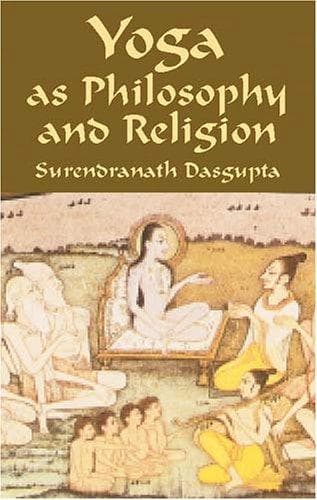
Yoga as philosophy and religionDasgupta, Surendranath
Religion
Yoga as philosophy and religion
Dasgupta, Surendranath
Hindu philosophy; Patañjali; Yoga
The real appearance of the guṇas does not come within the line of our
vision. That, however, which comes within the line of vision is but
paltry delusion and Vācaspati Miśra explains it as follows:—Prakṛti is
like the māyā but it is not māyā. It is trifling (_sutucchaka_) in the
sense that it is changing. Just as māyā constantly changes, so the
transformations of prakṛti are every moment appearing and vanishing and
thus suffering momentary changes. Prakṛti being eternal is real and thus
different from māyā.
This explanation of Vācaspati’s makes it clear that the word māyā is
used here only in the sense of illusion, and without reference to the
celebrated māyā of the Vedāntists; and Vācaspati clearly says that
prakṛti can in no sense be called māyā, since it is real.[13]
CHAPTER II
PURUSHA
We shall get a more definite notion of prakṛti as we advance further
into the details of the later transformations of the prakṛti in
connection with the purushas. The most difficult point is to understand
the nature of its connection with the purushas. Prakṛti is a material,
non-intelligent, independent principle, and the souls or spirits are
isolated, neutral, intelligent and inactive. Then how can the one come
into connection with the other?
In most systems of philosophy the same trouble has arisen and has caused
the same difficulty in comprehending it rightly. Plato fights the
difficulty of solving the unification of the idea and the non-being and
offers his participation theory; even in Aristotle’s attempt to avoid
the difficulty by his theory of form and matter, we are not fully
satisfied, though he has shown much ingenuity and subtlety of thought in
devising the “expedient in the single conception of development.”
The universe is but a gradation between the two extremes of potentiality
and actuality, matter and form. But all students of Aristotle know that
it is very difficult to understand the true relation between form and
matter, and the particular nature of their interaction with each other,
and this has created a great divergence of opinion among his
commentators. It was probably to avoid this difficulty that the
dualistic appearance of the philosophy of Descartes had to be
reconstructed in the pantheism of Spinoza. Again we find also how Kant
failed to bring about the relation between noumenon and phenomenon, and
created two worlds absolutely unrelated to each other. He tried to
reconcile the schism that he effected in his _Critique of Pure Reason_
by his _Critique of Practical Reason_, and again supplemented it with
his _Critique of Judgment_, but met only with dubious success.
In India also this question has always been a little puzzling, and
before trying to explain the Yoga point of view, I shall first give some
of the other expedients devised for the purpose, by the different
schools of Advaita (monistic) Vedāntism.
Public-domain text, read in full here on John Shaqi.
Reviews
Reviews
No reviews yet
Be the first to share your thoughts on this work.
Join the Discussion
Join the discussion
Sign in to leave a comment or review.
Sign InorCreate an account