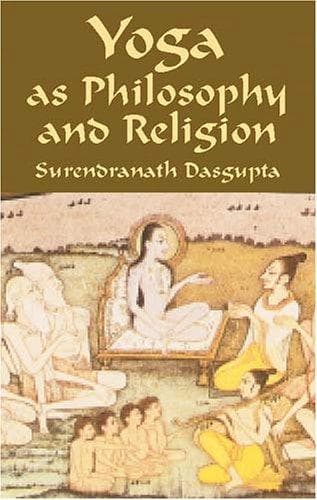
Yoga as philosophy and religionDasgupta, Surendranath
Religion
Yoga as philosophy and religion
Dasgupta, Surendranath
Hindu philosophy; Patañjali; Yoga
I. The reflection theory of the Vedānta holds that the māyā is without
beginning, unspeakable, mother of gross matter, which comes in
connection with intelligence, so that by its reflection in the former we
have Īśvara. The illustrations that are given to explain it both in
_Siddhāntaleśa_[14] and in _Advaita-Brahmasiddhi_ are only cases of
physical reflection, viz. the reflection of the sun in water, or of the
sky in water.
II. The limitation theory of the Vedānta holds that the all-pervading
intelligence must necessarily be limited by mind, etc., so of necessity
it follows that “the soul” is its limitation. This theory is illustrated
by giving those common examples in which the Ākāśa (space) though
unbounded in itself is often spoken of as belonging to a jug or limited
by the jug and as such appears to fit itself to the shape and form of
the jug and is thus called _ghaṭāvacchinna ākāśa_, i.e. space as within
the jug.
Then we have a third school of Vedāntists, which seeks to explain it in
another way:—The soul is neither a reflection nor a limitation, but just
as the son of Kuntī was known as the son of Rādhā, so the pure Brahman
by his nescience is known as the jīva, and like the prince who was
brought up in the family of a low caste, it is the pure Brahman who by
his own nescience undergoes birth and death, and by his own nescience is
again released.[15]
The _Sāṃkhya-sūtra_ also avails itself of the same story in IV. 1,
“_rājaputtravattattvopadeśāt_,” which Vijñāna Bhikshu explains as
follows:—A certain king’s son in consequence of his being born under the
star Gaṇḍa having been expelled from his city and reared by a certain
forester remains under the idea: “I am a forester.” Having learnt that
he is alive, a certain minister informs him. “Thou art not a forester,
thou art a king’s son.” As he, immediately having abandoned the idea of
being an outcast, betakes himself to his true royal state, saying, “I am
a king,” so too the soul realises its purity in consequence of
instruction by some good tutor, to the effect—“Thou, who didst originate
from the first soul, which manifests itself merely as pure thought, art
a portion thereof.”
Public-domain text, read in full here on John Shaqi.
Reviews
Reviews
No reviews yet
Be the first to share your thoughts on this work.
Join the Discussion
Join the discussion
Sign in to leave a comment or review.
Sign InorCreate an account