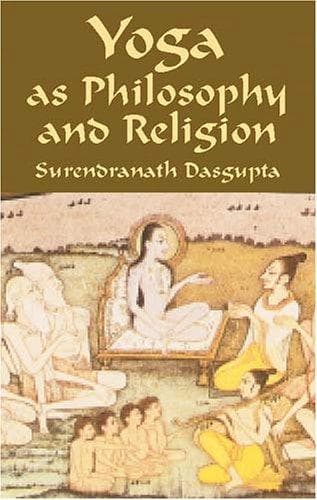
Yoga as philosophy and religionDasgupta, Surendranath
Religion
Yoga as philosophy and religion
Dasgupta, Surendranath
Hindu philosophy; Patañjali; Yoga
To summarise: We have seen that something like a union takes place
between the mind and purusha, i.e. there is a seeming reflection of
purusha in the mind, simultaneously with its being determined
conceptually, as a result whereof this reflection of purusha in the
mind, which is known as the self, becomes united with these conceptual
determinations of the mind and the former is said to be the perceiver of
all these determinations. Our conscious personality or self is thus the
seeming unity of the knowable as the mind in the shape of conceptual or
judgmental representations with the reflections of purusha in the mind.
Thus, in the single act of cognition, we have the notion of our own
personality and the particular conceptual or perceptual representation
with which this ego identifies itself. The true seer, the pure
intelligence, the free, the eternal, remains all the while beyond any
touch of impurity from the mind, though it must be remembered that it is
its own seeming reflection in the mind that appears as the ego, the
cogniser of all our states, pleasures and sorrows of the mind and one
who is the apperceiver of this unity of the seeming reflection—of
purusha and the determinations of the mind. In all our conscious states,
there is such a synthetic unity between the determinations of our mind
and the self, that they cannot be distinguished one from the other—a
fact which is exemplified in all our cognitions, which are the union of
the knower and the known. The nature of this reflection is a
transcendent one and can never be explained by any physical
illustration. Purusha is altogether different from the mind, inasmuch as
he is the pure intelligence and is absolutely free, while the latter is
non-intelligent and dependent on purusha’s enjoyment and release, which
are the sole causes of its movement. But there is some similarity
between the two, for how could the mind otherwise catch a seeming
glimpse of him? It is also said that the pure mind can adapt itself to
the pure form of purusha; this is followed by the state of kaivalya.
Public-domain text, read in full here on John Shaqi.
Reviews
Reviews
No reviews yet
Be the first to share your thoughts on this work.
Join the Discussion
Join the discussion
Sign in to leave a comment or review.
Sign InorCreate an account