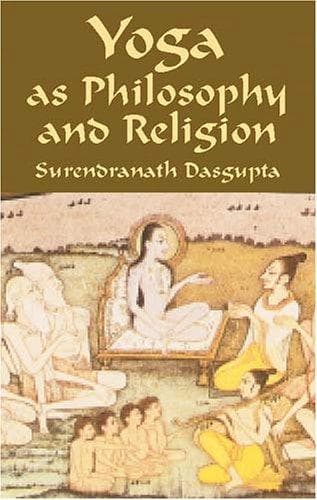
Yoga as philosophy and religionDasgupta, Surendranath
Religion
Yoga as philosophy and religion
Dasgupta, Surendranath
Hindu philosophy; Patañjali; Yoga
But the question arises, how is it that there can even be a seeming
reflection of purusha in the mind which is altogether non-intelligent?
How is it possible for the mind to catch a glimpse of purusha, which
illuminates all the concepts of consciousness, the expression
“_anupaśya_” meaning that he perceives by imitation (_anukāreṇa
paśyati_)? How can purusha, which is altogether formless, allow any
reflection of itself to imitate the form of buddhi, by virtue of which
it appears as the self—the supreme possessor and knower of all our
mental conceptions? There must be at least some resemblance between the
mind and the purusha, to justify in some sense this seeming reflection.
And we find that the last sūtra of the Vibhūtipāda says:
_sattvapurushayoḥ śuddhisāmye kaivalyaṃ_—which means that when the
sattva or the preponderating mind-stuff becomes as pure as purusha,
kaivalya or oneness is attained. This shows that the pure nature of
sattva has a great resemblance to the pure nature of purusha. So much
so, that the last stage preceding the state of kaivalya, is almost the
same as kaivalya itself, when purusha is in himself and there are no
thoughts to reflect. In this state, we see that the mind can be so pure
as to reflect exactly the nature of purusha, as he is in himself. This
state in which the mind becomes as pure as purusha and reflects him in
his purity, does not materially differ from the state of kaivalya, in
which purusha is in himself—the only difference being that the mind,
when it becomes so pure as this, becomes gradually lost in prakṛti and
cannot again serve to bind purusha.
I cannot refrain here from the temptation of referring to a beautiful
illustration from Vyāsa, to explain the way in which the mind serves the
purposes of purusha. _Cittamayaskāntamaṇikalpaṃ sannidhimātropakāri
dṛśyatvena svaṃ bhavati purushasya svāminaḥ_ (I. 4), which is explained
in _Yoga-vārttika_ as follows: _Tathāyaskāntamaṇiḥ svasminneva
ayaḥsannidhīkaraṇamātrāt śalyarishkarshaṇākhyam upakāram kurvat
purushasya svāminaḥ svam bhvati bhogasādhanatvāt_, i.e. just as a magnet
draws iron towards it, though it remains unmoved itself, so the
mind-modifications become drawn towards purusha, and thereby become
visible to purusha and serve his purpose.
Public-domain text, read in full here on John Shaqi.
Reviews
Reviews
No reviews yet
Be the first to share your thoughts on this work.
Join the Discussion
Join the discussion
Sign in to leave a comment or review.
Sign InorCreate an account