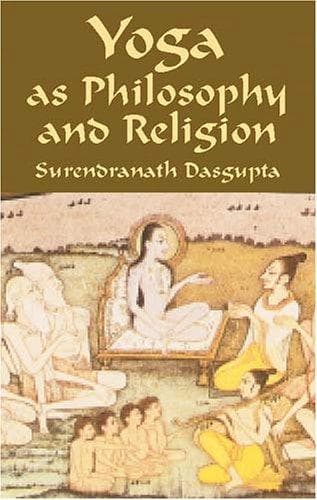
Yoga as philosophy and religionDasgupta, Surendranath
Religion
Yoga as philosophy and religion
Dasgupta, Surendranath
Hindu philosophy; Patañjali; Yoga
_Third argument_: There must be a supreme background of pure
consciousness, all our co-ordinated basis of experience. This background
is the pure actionless purusha, reflected in which all our mental states
become conscious. Davies explains this a little differently, in
accordance with a simile in the _Tattva-Kaumudī_, _yathā rathādi
yantrādibhiḥ_, thus: “This idea of Kapila seems to be that the power of
self-control cannot be predicted of matter, which must be directed or
controlled for the accomplishment of any purpose, and this controlling
power must be something external to matter and diverse from it. The
soul, however, never acts. It only seems to act; and it is difficult to
reconcile this part of the system with that which gives to the soul a
controlling force. If the soul is a charioteer, it must be an active
force.” But Davies here commits the mistake of carrying the simile too
far. The comparison of the charioteer and the chariot holds good, to the
extent that the chariot can take a particular course only when there is
a particular purpose for the charioteer to perform. The motion of the
chariot is fulfilled only when it is connected with the living person of
the charioteer, whose purpose it must fulfil.
_Fourth argument_: Since prakṛti is non-intelligent, there must be one
who enjoys its pains and pleasures. The emotional and conceptual
determinations of such feelings are aroused in consciousness by the
seeming reflection of the light of purusha.
_Fifth argument_: There is a tendency in all persons to move towards the
oneness of purusha, to be achieved by liberation; there must be one for
whose sake the modifications of buddhi are gradually withheld, and a
reverse process set up, by which they return to their original cause
prakṛti and thus liberate purusha. It is on account of this reverse
tendency of prakṛti to release purusha that a man feels prompted to
achieve his liberation as the highest consummation of his moral ideal.
Public-domain text, read in full here on John Shaqi.
Reviews
Reviews
No reviews yet
Be the first to share your thoughts on this work.
Join the Discussion
Join the discussion
Sign in to leave a comment or review.
Sign InorCreate an account